Vermeer
Girl with a Pearl Earring
The background was never a void. Two pigments faded over 350 years and erased a deep green curtain Vermeer painted her in front of. Everything you think you see is an accident of chemistry.
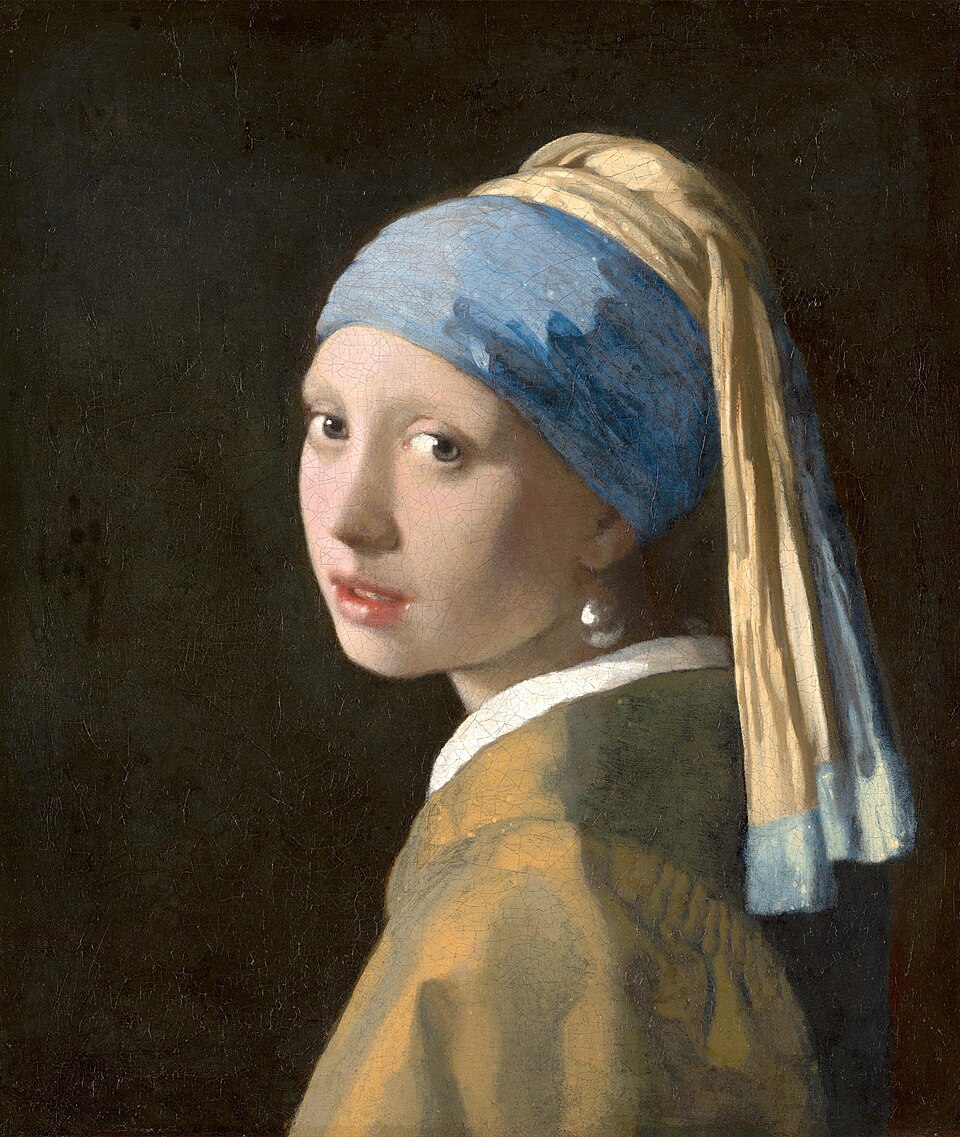
Johannes Vermeer, Girl with a Pearl Earring, c.1665. Public domain.
A girl turns to look at you. She wears a yellow and blue headscarf, a simple brown jacket, a large pearl earring. She is caught mid-turn, lips parted, eyes direct. The background is pure dark. She appears from nowhere, returns to nowhere. The composition is stripped to a single face and a single gesture: that turn.
The blue of her headscarf is ultramarine - ground from lapis lazuli, a semi-precious stone that in the seventeenth century was imported overland from the mines of Badakhshan, in what is now northeastern Afghanistan. It was, ounce for ounce, more expensive than gold. Vermeer used it with a profligacy that has baffled art historians given his persistent financial difficulties. He did not reserve it for accents or small areas. He saturated the cloth with it. The turban is not merely blue. It is the most expensive blue available to any painter in Europe.
The light enters from the upper left. This is consistent with every known interior that Vermeer painted, and with the arrangement of his studio on the Oude Langendijk in Delft, where a row of windows on the north-facing wall provided steady, indirect illumination. The light falls on her forehead, the bridge of her nose, the left side of her lower lip, and - crucially - the pearl. Everything else recedes into graduated shadow. The painting is, in structural terms, a study in the behavior of light striking a face at a single angle.
The painting is small. Forty-four and a half centimeters by thirty-nine. Barely larger than a sheet of letter paper. Almost everyone who sees it for the first time at the Mauritshuis remarks on this. They expected something larger. The painting's fame has expanded it in the collective imagination to a scale it never occupied on the wall.
The background was never empty. In 2018, the Mauritshuis launched "The Girl in the Spotlight," an unprecedented two-year research project that subjected the painting to macro X-ray fluorescence mapping, infrared reflectography, optical coherence tomography, and spectral imaging at resolutions no previous investigation had achieved. A team of scientists, conservators, and art historians examined every layer of the painting, from the ground preparation to the uppermost glazes. What they found was not a confirmation of what scholars already suspected. It was a revision.
Behind the girl, Vermeer had painted a deep green curtain. The curtain was not a flat backdrop. It was rendered with tonal variation - a graduated transition from green in the upper left to a darker, more saturated tone at the right - suggesting depth, folds, the way light falls unevenly across fabric. The pigments used were indigo and weld, layered over a dark underpainting. Over three and a half centuries, both pigments degraded. Indigo is a plant-based dye with known fugitive properties. Weld, derived from the mignonette plant, is similarly vulnerable to photochemical decomposition. Together, they faded to near-transparency, leaving only the dark ground beneath them visible. The austere black background that twentieth-century critics celebrated as "modern" or "minimalist" was neither. It was the ghost of something that had been lush and present.
The macro X-ray fluorescence mapping also revealed eyelashes. In early photographs of the painting, taken before the most recent restorations, faint traces of individual lashes are visible along her upper lids. By the time of the 2018 scan, these had deteriorated to the point of invisibility under normal light, but the fluorescence data confirmed their presence: Vermeer had painted delicate, individual eyelashes, hair by hair. The girl we know - with her wide, slightly startled, lash-less gaze - is not the girl Vermeer finished. She once looked at you through framed eyes.
Along the edge of her headscarf, the researchers identified pentimenti in the strict sense: small corrections where Vermeer adjusted the width and fall of the cloth, painting it one way, then painting over it to try another. He was uncertain about the turban. He revised it. The final line of the fabric is not where it first was.
Background: A deep green curtain, painted with indigo and weld over a dark underpainting, with graduated tonal variation. Both pigments degraded over 350 years to near-transparency.
Eyelashes: Individual lashes painted along the upper lids, visible in early photographs but now too deteriorated to see without spectral imaging.
Turban: Multiple revisions to the edge of the headscarf, visible as pentimenti beneath the final paint layer.
Skin tones: Thin, translucent glazes of lead white, ochre, and vermilion applied in precise layers - some areas only microns thick.
The pearl: No hook or mounting hardware painted. No wire, no clasp, no visible mechanism of attachment. The pearl is suspended by nothing.
"The emptiness we have been reading as austere and modern is the decay of something that was once lush and green."
She is not a portrait. There is no known sitter, no commission record, no name attached to this woman in any document from Vermeer's lifetime. She is a tronie: a Dutch Golden Age term for a character study, a painted type rather than a specific individual. The tronie was a recognized genre in the seventeenth-century Dutch art market. It was distinct from portraiture. A portrait recorded a person. A tronie recorded an expression, a costume, a quality of light on a face. It was made not on commission but for the open market - to be sold at auction, through dealers, or from the painter's studio to whoever found it appealing.
Vermeer made three or four tronies, depending on how strictly you define the category. The "Study of a Young Woman" in the Metropolitan Museum is generally accepted as one. The "Girl with a Flute" at the National Gallery of Art, if it is by Vermeer at all, may be another. "Girl with a Red Hat" is a probable third. None of them has a name. None was commissioned. All of them were made for the market. This one - the girl turning over her left shoulder to meet your eye - has eclipsed not only the others but virtually every other painting in the Dutch Golden Age. It is the most reproduced, most visited, most commercially exploited image Vermeer ever produced. And it was, in all likelihood, a speculative painting, made without a buyer in mind.
The painting disappeared from the historical record for nearly two hundred years. No inventory of Vermeer's estate at his death in 1675 lists it by a description that can be matched with certainty. No collector's catalogue between 1675 and 1881 mentions it in terms that are unambiguous. On the 16th of May, 1882, at an auction in The Hague, a painting described as a tronie in the antique Turkish style was purchased by Arnoldus Andries des Tombe, a military officer and collector. He paid two guilders and thirty cents. Adjusted for inflation, this amounts to roughly twenty-eight euros. Des Tombe appears to have recognized it. He may have sought it out deliberately - the evidence is ambiguous. When he died in 1902, his will bequeathed it to the Mauritshuis, where it has hung in an increasingly prominent position ever since.
Two guilders and thirty cents. For 217 years, nobody came looking for it.
- The earring is two brushstrokes. Look at it closely in any high-resolution reproduction. There is a small white comma of highlight and almost nothing else. The sense of a hanging, luminous sphere is created by implication, by the space around those two marks.
- The lower lip has a single dot of highlight. Just below centre. It is what makes the mouth look wet, slightly open, as if she is about to speak. Remove it in your mind and she becomes a different painting.
- The green curtain was always there. Every time someone called the dark background "bold" or "minimalist" or "modern," they were describing an accident of chemistry. The painting we know is not the painting Vermeer made.
- The turban is not European. It is wound in an Oriental style - Turkish, or an approximation of it. Exoticism was a standard feature of tronies: the subject was meant to be striking, unfamiliar, suggestive of distant places. Vermeer was not painting a Dutch girl as she would have appeared on the street. He was constructing a fiction of otherness.
- The painting is tiny. 44.5 by 39 centimeters. Stand in front of it at the Mauritshuis and it is barely larger than the span of two outstretched hands. The intimacy is physical, not just emotional. She is close because the painting forces you close.
- The soft highlights may be camera obscura effects. The diffused gleam on the pearl, the wet dot on the lower lip, the unfocused luminosity at the tip of her nose - these are consistent with what a painter would see if he were projecting an image through a lens onto his canvas. Philip Steadman's 2001 study demonstrated that many of Vermeer's interiors could be reconstructed as views through a camera obscura positioned in a specific corner of his studio. Whether Vermeer traced from the projection or simply trained his eye to replicate its optical qualities is debated. What is not debated is that the highlights in this painting behave like focused light, not like painted imitation of light.
- Only 34 to 36 Vermeer paintings survive. The exact count depends on which disputed attributions you accept. Of those, this is the most famous by a wide margin. And we do not know who she is.
The pearl is impossible. No pearl earring of the size Vermeer depicted existed in the seventeenth-century Netherlands. Natural pearls of that diameter - roughly the size of a large marble - were objects of extraordinary rarity even in the courts of Europe. The painting does not show a court. It shows a girl in a simple jacket with a cloth turban. The incongruity has been noticed since the painting was first studied seriously in the early twentieth century, but it was art historian Timothy Brook who stated the conclusion plainly: it is almost certainly not a pearl at all.
Brook, in his 2008 book Vermeer's Hat, proposed that the earring was polished tin or glass - a costume ornament, the kind that Dutch painters and their models kept in studio prop collections alongside the turbans, furs, helmets, and exotic fabrics that recur across dozens of tronies by different artists. The 2018 Mauritshuis investigation confirmed something stranger. There is no hook. There is no wire. There is no clasp, no pin, no mounting hardware of any kind painted beneath or around the pearl. The earring does not hang from anything. Vermeer painted its luminous presence - its weight, its glow, its teardrop shape suspended in space next to her jaw - without painting any mechanism for its suspension.
The pearl floats. It is attached to nothing. It is held in place by the painting itself, by your willingness to accept that it belongs there. Vermeer did not paint jewelry. He painted light - a curved surface catching a source of illumination and returning it to your eye. The "pearl" is a study in reflectance: two strokes of lead white on a dark ground, producing an object that is more convincing as a phenomenon of light than it could ever be as a physical thing.
"She is not looking at the painter. She is looking at whoever is standing where the painter stood. That has been you, for 350 years."
Vermeer did not draw. Infrared reflectography of the Girl with a Pearl Earring - and of most of his other paintings - reveals no underdrawing beneath the paint surface. No contour lines, no transferred cartoons, no charcoal sketches over which the colors were built. This is unusual for a seventeenth-century painter. It was standard workshop practice to establish the composition in line before applying pigment. Vermeer appears to have skipped the step entirely. He built the image directly in paint, working from dark to light in thin, translucent glazes layered with extreme precision.
The technique is closer to photography than to painting. A photographer does not draw the world and then fill it in. A photographer exposes a surface to light and records what the light does. Vermeer worked in a similar register. He laid a dark ground - in this case, a warm, near-black base layer - and then applied the lightest tones on top, stroke by stroke, building the face and turban out of accumulated brightness. The shadowed side of her face is not "painted in shadow." It is the ground showing through, with the thinnest possible glazes modulating its temperature. The lit side is where the paint is thickest, most opaque, most assertively present. He was, in the most literal sense, adding light.
The lip highlight is a single dot of lead white, applied with the tip of a brush. It is perhaps two millimeters across. It is what makes the mouth appear moist, slightly open, alive. The pearl highlight is the same gesture at a larger scale: a comma of white on a dark field, producing the illusion of a three-dimensional reflective surface. Vermeer's entire method depended on this principle. The image is not a description of a face. It is a record of how light behaves when it meets one.
Some areas of the skin are only microns thick - layers of lead white, ochre, and vermilion so fine that the ground beneath them alters their apparent color. This is not impasto. This is not the thick, confident brushwork of Rembrandt or Hals. This is restraint at a molecular level. Vermeer painted as though he were developing an exposure, letting the image emerge from the dark by controlled additions of light rather than by modeling form.
She is turning. Not turned - turning. The moment Vermeer captured is not a pose held still but a motion arrested in transit. Her body is angled away from us. Her face has come around over her left shoulder. Her eyes have arrived at ours. Her lips are parted. She has either just begun to speak or just decided not to. The entire painting exists in this sliver of time between one state and another: between looking away and looking at, between silence and speech, between private and observed.
The gaze itself is the painting's central act. She does not look past you, or through you, or at a point above your shoulder the way many painted figures do. She looks at you. Directly, unambiguously, from a distance of about eighteen inches - the distance at which Vermeer, working at his easel, would have been from the canvas. When you stand in front of the painting at the Mauritshuis, you stand where Vermeer stood. Her eyes are calibrated to that distance. Move to the side and the illusion weakens. Step closer and it intensifies. The painting has an ideal viewing position, and it is the painter's position.
This creates an intimacy that has no equivalent in Dutch Golden Age painting. Rembrandt's self-portraits engage the viewer, but from a place of settled self-knowledge. Hals's laughing figures are performing for an audience. Her gaze is different. It is a response. She has been interrupted. She has turned to see who is there. And the person who is there - the person who has always been there since the paint dried - is you. The painting does not allow you to be a spectator. It makes you a participant. You are the reason she turned.
For three centuries, she was a minor work by a minor Dutch painter. Vermeer himself was largely forgotten after his death in 1675. He left his wife, Catharina Bolnes, with eleven surviving children and catastrophic debts. His paintings were dispersed, misattributed, lost. It was not until the French critic Theophile Thore-Burger published a series of articles in 1866, identifying and cataloguing Vermeer's surviving works, that the painter was rediscovered. Even then, the recovery was slow. The Girl with a Pearl Earring was not the painting that led the revival. It was the last to arrive.
The transformation began with Tracy Chevalier's 1999 novel, Girl with a Pearl Earring, which imagined the painting's creation through the eyes of a fictional maid in Vermeer's household named Griet. The novel was translated into thirty-eight languages. The 2003 film adaptation, directed by Peter Webber and starring Scarlett Johansson in the title role, extended the image into global popular culture. Johansson's face, wrapped in a blue and gold turban, became for millions the referent for the original. The label "the Dutch Mona Lisa," which had circulated in art criticism since at least the 1990s, became mainstream.
The comparison to the Mona Lisa is instructive. Both paintings are small. Both depict a woman whose identity is uncertain. Both have been elevated by narrative - by the stories told about them rather than by anything intrinsic to the image that earlier centuries recognized as supreme. The Mona Lisa became the world's most famous painting after it was stolen in 1911; the Girl with a Pearl Earring became the world's most visited tronie after a novelist imagined a love story behind it. In both cases, fame was an event, not a gradual recognition. Something happened, and the painting was never anonymous again.
In 2014, a prankster placed a poster reproduction of the painting at street level in The Hague and waited to see how many people would stop. Hundreds did. The Mauritshuis now sells more merchandise bearing her image than any other item in its collection. She appears on tote bags, phone cases, umbrellas, face masks. The painting that nobody wanted for two guilders and thirty cents is now the economic engine of a national museum.
Why this one? Why, of all the paintings in the Dutch Golden Age, did this particular tronie become the image that seven million people a year travel to The Hague to see? The answer is probably the anonymity. A portrait of a known person is closed. You know who she was, what she did, how she lived and died. A tronie is open. She is nobody. Her name, her circumstances, her relationship to the painter, her reason for turning - none of it survives. She is a surface for projection. She can be a maid, a daughter, a lover, a stranger. She can be whoever you need her to be. The painting's power is not in what it shows but in what it withholds.
Only 34 to 36 paintings by Vermeer survive. No letters. No diary. No written account of his methods, his intentions, his models, or his daily practice. No drawings have ever been attributed to him with certainty. No contracts or commission records for any of his tronies exist. The entire body of evidence for how Vermeer worked consists of the paintings themselves and a handful of legal and financial documents - records of debts, a death inventory, a few transactions. He is the most famous painter in the history of art about whom almost nothing is known.
We do not know who the girl was. We do not know if she was real - if a model sat in his studio on the Oude Langendijk and turned her head over her left shoulder while wearing a borrowed turban and a prop earring - or if she was invented entirely, assembled from observation and memory and the logic of light on skin. We do not know why Vermeer painted a green curtain behind her and then, by the slow chemistry of oxidation and photodegradation, lost it. We do not know if he would have wanted us to see the painting as we see it now - a face floating in a void - or if he would have considered it damaged, incomplete, a ruin of his original intention.
We do not know why she is turning. The painting gives us the turn - the motion, the arrested instant, the parted lips - without giving us its cause. Someone spoke. Something fell. A door opened. Or nothing happened at all, and Vermeer simply asked his model to look at him, and she did, and what he saw in that glance was enough to paint.
What we have is two brushstrokes of light where an earring should be, a blue turban that cost more than the painting sold for, a face built from the dark up in glazes so thin they measure in microns, and a background that was supposed to be green. We have the painting Vermeer made, and we have the painting that time made from it, and they are not the same painting. The girl you see is a collaboration between a seventeenth-century painter and 350 years of chemistry. She is partly his. She is partly what happened after.
Vandivere, Abbie, et al. "The Girl in the Spotlight: Vermeer at Work, His Materials and Techniques in Girl with a Pearl Earring." Heritage Science 7.66 (2019). Principal investigators: Abbie Vandivere, Joen Hermans, and team, Mauritshuis, The Hague.
Brook, Timothy. Vermeer's Hat: The Seventeenth Century and the Dawn of the Global World. Bloomsbury, 2008.
Steadman, Philip. Vermeer's Camera: Uncovering the Truth Behind the Masterpieces. Oxford University Press, 2001.
Thore-Burger, Theophile. "Van der Meer de Delft." Gazette des Beaux-Arts, 1866.
Chevalier, Tracy. Girl with a Pearl Earring. HarperCollins, 1999.
Wadum, Jorgen, et al. Vermeer Illuminated: Conservation, Restoration and Research. Mauritshuis, 1994.