Velazquez
Las Meninas
Every figure named, every pentimento documented, every mirror theory tested. Velazquez painted himself into the company of kings - then went back and added the proof.
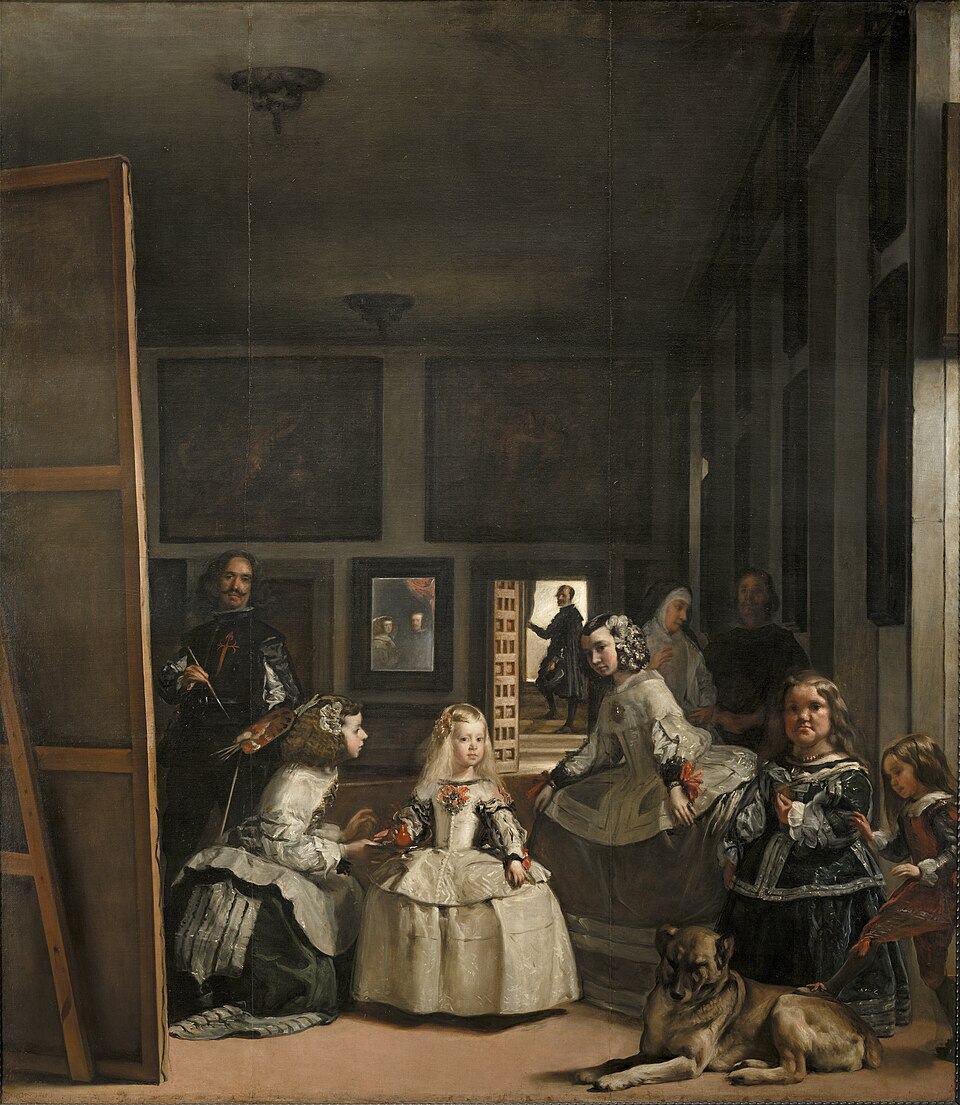
Diego Velazquez, Las Meninas, 1656. Oil on canvas, 318 x 276 cm. Public domain.
A large room in the Royal Alcazar of Madrid. The canvas measures 318 by 276 centimeters - roughly 10.5 by 9 feet - making it one of the largest paintings Velazquez ever produced. Eleven figures and one animal occupy the space. Every one of them has a name.
At the centre stands the five-year-old Infanta Margarita Teresa, eldest surviving daughter of Philip IV and his second wife Mariana of Austria. She is the brightest figure in the room, her blonde hair and wide panniers of white silk catching almost all of the available light. She does not look at the painter. She looks at us.
Flanking her are her two meninas - ladies-in-waiting, maids of honour. To the Infanta's right (our left), Maria Agustina Sarmiento de Sotomayor kneels and offers her a small red clay cup, a bucaro, on a gold tray. To the Infanta's left (our right), Isabel de Velasco curtsies, half-turning toward the royal parents we cannot see.
In the right foreground stand two dwarfs. Mari Barbola, a German dwarf whose real name was Maria Barbola, stares directly outward with an expression of absolute composure. Beside her, the Italian dwarf Nicolas Pertusato places his foot on the back of a large dog - a Spanish mastiff - who lies on the floor with the resigned stillness of an animal accustomed to being stepped on by children. Pertusato is testing whether the dog will react. The dog will not.
Behind the Infanta, half-swallowed by shadow, stand two chaperones. Marcela de Ulloa, the guardadamas - literally, guardian of the ladies - appears in her widow's habit, speaking to an unidentified male attendant beside her, possibly a guardadamas bodyguard. She is the only figure engaged in private conversation.
At the far back of the room, framed in a bright doorway, stands Jose Nieto Velazquez (no relation to the painter despite sharing a surname). He was the queen's aposentador - the palace chamberlain responsible for arranging the royal quarters. He pauses on a step, one hand pulling back a curtain, his body silhouetted against the stairwell light. He is either arriving or leaving. The painting does not say.
And on the left, standing behind a canvas so large we can only see its back, the painter himself: Diego Rodriguez de Silva y Velazquez, brush in one hand, palette in the other, looking outward past the edge of the picture toward whatever he is painting. Toward us.
On the back wall, between two large paintings barely visible in the gloom, hangs a mirror. In it, two small figures glow: Philip IV and Mariana of Austria. The king and queen of Spain. They are reflected. They are present. But they are not in the room as we see it. They exist only as light caught in glass.
The most famous pentimento in Las Meninas is visible to the naked eye. The red cross of the Order of Santiago on Velazquez's chest was not part of the original painting. He completed the canvas in 1656. He did not receive the knighthood until November 1659, three years later. Someone returned to this finished masterpiece and painted the cross onto it.
According to Antonio Palomino, who published his biography of Velazquez in 1724 and who had access to sources now lost, it was King Philip IV himself who picked up a brush and painted the cross. This is almost certainly legend - Palomino was writing sixty-eight years after the fact - but it is a legend the Prado has never definitively rejected. The museum's own position is that the cross was "probably added by Velazquez or an assistant" after the investiture in 1659. Either way, a completed work was reopened. A finished composition was corrected to reflect a change in the painter's status that had not yet occurred when the painting was made.
But X-ray analysis conducted by the Prado's conservation department has revealed deeper, less visible pentimenti beneath the surface.
- Velazquez's head was repositioned. In the earlier state, his face was turned more sharply toward the canvas he is painting. In the final version, he turns outward to face us more directly. He chose, in revision, to meet our gaze rather than attend to his work.
- The position of his right hand was changed. The hand holding the brush was moved during painting. The X-rays show a ghost of the earlier placement beneath the final brushwork.
- The Infanta's head was slightly repositioned. Her face shifted during the painting process - not dramatically, but enough to register in the radiograph. The precise tilt of her gaze was adjusted.
- The mirror image was modified. The reflection of the royal couple appears to have been reworked. Whether the mirror originally showed something different - a different angle, different figures, or a different composition on the canvas Velazquez is painting - remains a subject of scholarly debate.
These are not preliminary sketches visible through thin paint. They are deliberate revisions to a composition Velazquez reconsidered as he worked. The painting we see is the result of a sustained argument between the painter and his own decisions.
Velazquez's head: Repositioned from a sharper turn toward his canvas to face the viewer more directly. He chose, in revision, to meet our gaze.
Right hand: The brush hand was moved during painting. A ghost of the earlier placement is visible in the radiograph.
Infanta's head: Slightly repositioned - the precise tilt of her gaze was adjusted during the painting process.
The mirror image: The reflection of the royal couple was reworked. Whether it originally showed something different remains debated.
The Santiago cross: Added to Velazquez's chest three years after completion, following his 1659 knighthood. The most visible pentimento in the painting.
"Where exactly are we standing? In front of the painting, or inside it? That is the question Velazquez refuses to answer."
Velazquez was court painter to Philip IV for nearly thirty-seven years. He arrived at court in 1623, aged twenty-four, summoned after a portrait of the king so impressed Philip that he declared no other painter would ever make his likeness. He kept that promise. Velazquez painted Philip IV more than thirty times across four decades.
But Velazquez wanted more than to paint. He wanted what painting could not, in seventeenth-century Spain, automatically confer: nobility. Painting was classified as a manual art - a craft, not a liberal profession. A painter worked with his hands. A gentleman did not. Velazquez spent his career trying to prove that painting was an intellectual act, that the artist was the equal of the poet and the philosopher, and that he personally was fit for the company of knights.
The Order of Santiago was the proof he sought. It was one of the most exclusive chivalric orders in Spain, reserved for men of noble blood and - critically - limpieza de sangre, purity of blood. Applicants had to demonstrate that their lineage contained no Jewish or Moorish ancestry for multiple generations. The investigation into Velazquez's family background took over a year. One hundred and forty-eight witnesses were called. The inquiry examined his grandparents, his wife's family, his origins in Seville. The problem was not merely his profession. There were questions about whether his family had converso ancestry - Jewish converts to Christianity - a taint that would disqualify him automatically.
Philip IV himself reportedly intervened, personally nominating Velazquez and pressuring the order's council to approve the application. A papal dispensation was ultimately required to waive certain deficiencies in the genealogical record. The knighthood was granted on November 28, 1659.
The little girl at the centre of the painting, Infanta Margarita Teresa, was five years old when Velazquez painted her here. She would be betrothed to Holy Roman Emperor Leopold I at age three, married at fifteen, and dead at twenty-one, having given birth to six children in six years, of whom only one survived infancy. Velazquez himself would die on August 6, 1660, less than a year after receiving the cross he spent his life pursuing. He had held it for eight months.
The painting was made inside the room where it is set. Velazquez knew every person in it. He painted them not as subjects arranged for a portrait but as people interrupted in the middle of an afternoon - the Infanta arriving, the maids attending, the painter working, the dog sleeping. It is the most casual painting of royalty ever produced, and it was made by a man who was, at that moment, still technically a servant.
- The paintings on the back wall are not decoration. They are copies of works by Peter Paul Rubens and Jacob Jordaens, and both depict contests between mortals and gods over artistic supremacy. One shows Minerva punishing Arachne, the mortal weaver who dared challenge a goddess and produced a tapestry the gods could not fault. The other shows Apollo's victory over the satyr Pan in a musical competition. Both are about artists competing with divine powers - and both end badly for the mortal. Velazquez hung paintings about the cost of artistic ambition on the wall directly behind himself painting.
- The mirror does not reflect what it should. If the king and queen are standing where we stand, the mirror should show them at an angle consistent with its position on the back wall. But the geometry has never been satisfactorily resolved. Some scholars argue the mirror reflects the canvas Velazquez is painting, not the room itself. Others have built physical models of the space and concluded the reflection is optically impossible from any single viewpoint. The debate has continued for three and a half centuries without resolution.
- The doorway figure mirrors the painter. Jose Nieto, the queen's chamberlain, stands at the back of the room framed in light. Velazquez stands at the front framed by his canvas. Both men were aposentadores - palace officials responsible for arranging royal spaces. Nieto pauses on a step while Velazquez pauses mid-brushstroke. One is arriving or departing; the other is creating or observing. The painting constructs a corridor of looking between them: two functionaries of the same rank, performing parallel acts of service, one visible and one silhouetted, framing the royal child between them.
- The canvas is blank to us. We see only its back. The stretcher bars, the wooden frame, the raw reverse side of whatever Velazquez is painting. Everything the painter is creating in the painting is hidden from us. We are watching an act of creation whose result we cannot see - except that we are, at this moment, looking at it. The painting depicts its own making while concealing what is being made.
- The real mirror makes every viewer a monarch. The reflected figures of Philip IV and Mariana of Austria appear at the exact point in the composition where the viewer's own position would be reflected. We stand where the king and queen stand. The painting places whoever looks at it in the position of Spanish royalty. For a painter fighting to prove he was noble enough to receive a knighthood, this was not a casual choice.
In 1966, Michel Foucault opened The Order of Things - his study of the structures underlying Western knowledge - with a twelve-page analysis of Las Meninas. It was not a chapter about art. It was a chapter about the conditions of representation itself, and he chose this painting to demonstrate how those conditions work.
Foucault's argument, stripped to its core, is this: Las Meninas is the first painting that makes the act of representation its own subject. The painter paints. But what does he paint? He looks at us. The mirror shows the king and queen. The canvas faces away. The subject of the painting - the thing being represented - occupies the one position in the entire composition that the painting cannot show: the place where the viewer stands.
In Foucault's reading, three roles that are normally separate collapse into a single point in space. The painter looks at his subject. The subject (the royals) poses for the painter. The viewer looks at the result. But in Las Meninas, all three - painter's gaze, royal subject, and viewer's position - converge on the same spot. The person who looks, the person who is depicted, and the person who made the depiction all occupy the same coordinates. Representation, in this painting, turns back on itself. The painting is about looking at a painting about looking.
Foucault did not treat this as a clever trick. He treated it as a rupture in the history of Western thought - the moment when the "classical" episteme, in which representation was transparent and subjects could be clearly arranged and classified, began to show its own limits. The painting, in his reading, is not a portrait or a genre scene or a royal commission. It is a philosophical diagram of what representation can and cannot do.
Whether Velazquez intended any of this is, strictly speaking, unknowable. Foucault did not claim he did. The argument was not about the painter's intention but about the painting's structure - what it does regardless of what its maker meant. Forty years of art-historical response have contested, refined, and occasionally dismissed Foucault's reading, but none have replaced it. Las Meninas remains the painting that philosophers reach for when they need to explain what it means to look.
The scene takes place in the Cuarto del Principe - the Prince's Quarter - in the Real Alcazar of Madrid. By 1656 this room was no longer a royal apartment. It had been given over to Velazquez as his studio. The paintings visible on the back wall, the high ceilings, the deep recession of space into the lit doorway at the rear - all of this was real. Velazquez painted the room he worked in every day, with the people who moved through it.
The Alcazar burned down on Christmas Eve, 1734. The fire destroyed most of the building and hundreds of paintings in the royal collection. Las Meninas survived because it was among the works rescued during the blaze - reportedly cut from its stretcher and thrown from a window to save it. The room Velazquez painted no longer exists. The building that contained it no longer exists. The only record of that specific space, with its specific light and its specific arrangement of copied paintings on the back wall, is the painting itself.
When Philip V built the new Royal Palace on the same site, the Alcazar's floor plan was not preserved. No architectural drawings of the Cuarto del Principe survive in sufficient detail to reconstruct the room precisely. Scholars who have attempted to map the space - calculating the position of the mirror, the angle of light from the windows on the right wall, the depth of the room from the foreground to Jose Nieto's doorway - have worked almost entirely from the painting. Las Meninas is both the portrait of a room and, now, the only evidence that the room existed.
Velazquez painted Las Meninas in his late style, which is to say: in a manner that would not be fully understood for another two hundred years. Seen from a distance of three or four meters, every surface in the painting resolves into precise, luminous representation. The Infanta's hair gleams. The silk of her dress catches light exactly as silk does. The mastiff's fur is warm and dense. The room recedes with perfect atmospheric perspective.
Step closer and the illusion dissolves. The Infanta's hair is a sequence of rapid, almost careless strokes - pale gold dragged across darker ground with a loaded brush. The lace at her bodice is not painted in detail; it is suggested by a few flicks of lead white that, at arm's length, read as solid fabric. The dog is built from broad, overlapping planes of brown and ochre. Nothing is finished in the way that contemporary Spanish painting demanded finish. Everything is suggested, implied, performed.
This was radical. In 1656, the dominant standard for painting in Spain was the tightly rendered, highly detailed manner derived from Flemish practice. Velazquez had trained in Seville under Francisco Pacheco, who insisted on careful drawing and smooth modelling. What Velazquez developed in his late career abandoned those principles almost entirely. He painted with speed, confidence, and a looseness that his contemporaries found difficult to categorize.
Edouard Manet, visiting the Prado in 1865, called Velazquez "the painter of painters" - le peintre des peintres. The Impressionists recognized in his late technique a way of painting they thought they had invented: the idea that a painting need not describe every surface in detail, that the eye of the viewer completes what the brush begins, that suggestion is more truthful than enumeration. Velazquez's technique anticipated Impressionism by roughly two centuries. He arrived there alone, inside a palace, painting for an audience of one king.
Michel Foucault, The Order of Things (1966), Chapter 1: "Las Meninas." Antonio Palomino, El Museo pictorico y escala optica (1724), Volume III: "Lives of the Eminent Spanish Painters and Sculptors." Museo del Prado conservation records and X-ray analyses. Jonathan Brown, Velazquez: Painter and Courtier (Yale, 1986). Svetlana Alpers, The Vexations of Art: Velazquez and Others (Yale, 2005). John F. Moffitt, "Velazquez in the Alcazar Palace in 1656: The Meaning of the Mise-en-Scene of Las Meninas," Art History, Vol. 6, No. 3 (1983). Joel Snyder, "Las Meninas and the Mirror of the Prince," Critical Inquiry, Vol. 11, No. 4 (1985).