Rembrandt
The Night Watch
It was never called The Night Watch. It was trimmed on all four sides to fit a doorway. Centuries of varnish turned daylight to darkness. His face was hidden in the crowd for 377 years.
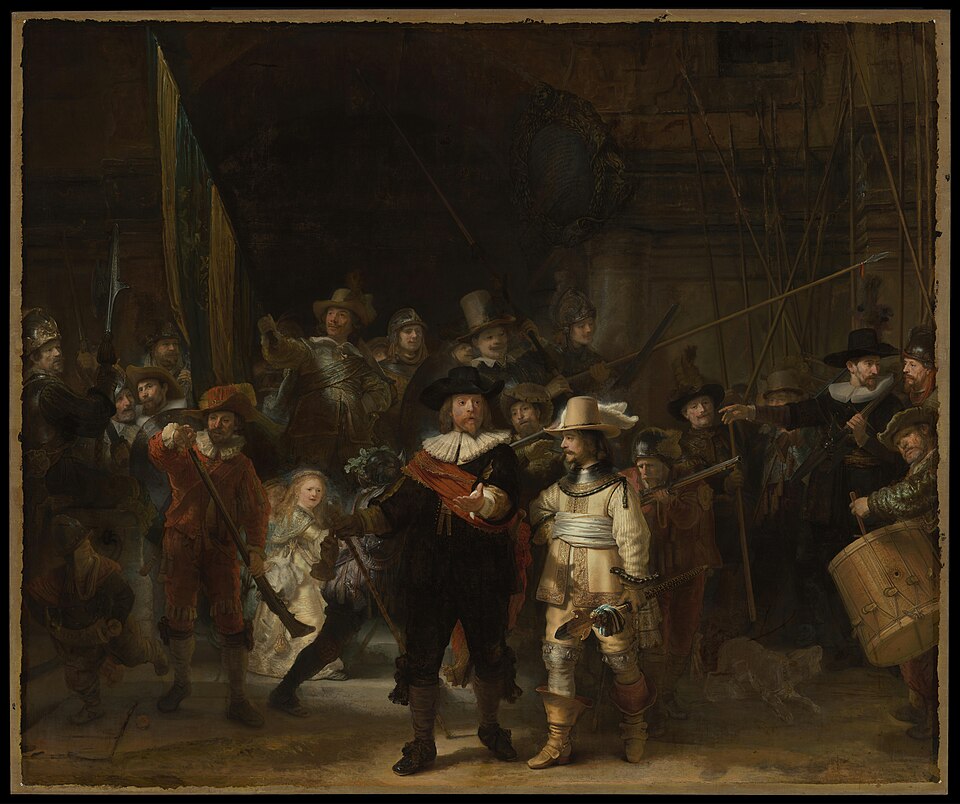
Rembrandt van Rijn, The Night Watch, 1642. Public domain.
At the centre of the canvas, Captain Frans Banninck Cocq strides forward dressed in black with a red sash, his right hand extended in a gesture of command. His shadow falls across the brilliant yellow coat of his lieutenant, Willem van Ruytenburch, who holds a partisan - a long-bladed polearm - and turns slightly toward the captain as if receiving an order. The shadow is not incidental. It is cast by the same strong light that illuminates the lieutenant's coat to an almost supernatural brightness, and it lands precisely on van Ruytenburch's midsection, linking the two central figures physically through light and shade. Between them, the painting declares its subject: a militia company assembling to march out. This is not a static group portrait. It is a scene in motion, caught at the instant the order has been given and the company has not yet formed ranks.
Around the two central figures, 34 people crowd the composition. A musketeer in red loads his weapon at the left, ramming powder into the barrel with a scouring stick. Behind him, another fires a caliver, and the smoke from the discharge drifts across the faces behind in a pale, diagonal haze. A drummer at the far right beats a cadence on a large military drum. A standard-bearer raises the company's blue and gold flag. Pikemen hoist their weapons overhead at varying angles, the long shafts creating a lattice of diagonals that Rembrandt used to structure the upper third of the painting and direct the eye across the crowd. A boy runs through the assembly at the left edge. A man in a helmet peers out from behind the captain's shoulder. The scene has the density and disorder of an actual military assembly - people arriving at different moments, some ready, some still preparing, none of them posed for the painter.
Near the centre, partly lost in the crowd, a small girl in a golden dress appears almost to glow. She is the brightest figure in the painting besides the lieutenant. A dead chicken hangs from her waist by its claws - and the claws are the critical detail, though their meaning is invisible to a modern viewer without context. She carries a pistol and a drinking horn. She is not a child who wandered into a militia portrait. She is a symbolic figure, a living emblem of the company, and every object she carries encodes a specific meaning that her contemporaries would have read as immediately as a logo.
The painting is enormous. The current canvas measures 363 by 437 centimetres - taller than a standard doorway, wider than most walls in a private home. It was the largest commission Rembrandt had received up to that point and remains the largest of his surviving works. Light does not fall evenly across the scene. Some figures are fully illuminated, bathed in a warm gold that picks out their clothing and faces with almost theatrical intensity. Others are pushed into near-darkness, their features barely distinguishable from the shadowed background. A man who paid his hundred guilders for a place in the painting might find himself rendered as little more than a nose above a shoulder. This is a militia portrait that treats its subjects as characters in a drama rather than equals in a corporate commission. Everyone who paid for the painting is in it. Not everyone who paid is visible.
This is not a night scene. The title "The Night Watch" was not used during Rembrandt's lifetime and does not appear in any seventeenth-century source. The painting's original name, recorded in a militia album kept at the Kloveniersdoelen, was "The Company of Captain Frans Banninck Cocq and Lieutenant Willem van Ruytenburch." It described a daylight assembly. The arch in the background casts a shadow consistent with a midday or early afternoon sun. The warm golden light that strikes the captain, the lieutenant, and the girl in the gold dress enters from the upper left - strong, direct, and unambiguously solar. There is no moon, no torchlight, no lantern. This was always a painting of day.
What happened was chemistry. Over the following two centuries, the painting accumulated layers of dark varnish - oxidized oil and natural resin applied periodically to protect and refresh the paint surface. Each new coat was transparent when applied and darkened as it aged, turning amber, then brown, then nearly opaque. By the eighteenth century, so many layers had built up that the painting appeared to depict a scene in near-darkness. Viewers assumed they were looking at a night patrol or an evening assembly. The name "The Night Watch" began to circulate in popular usage and, by the early nineteenth century, was established fact. When the painting was cleaned in the 1940s, removing the accumulated varnish layer by layer, the daylight re-emerged. The shadows were revealed as Rembrandt's deliberate chiaroscuro, not nocturnal gloom. But the name had been fixed for more than a hundred years, and corrections do not travel as well as myths. It is still called The Night Watch in every museum label, every guidebook, every postcard sold in the Rijksmuseum gift shop.
Beneath the visible paint surface, imaging has revealed Rembrandt's earlier plans for the composition. A preparatory sketch on the ground layer shows a slightly different arrangement of figures, with more spears and a broader distribution of the militia members across the canvas. He adjusted positions as he painted - moving figures, changing the angle of weapons, reworking the spatial relationships between the central pair and the crowd behind them. These are pentimenti in the strict sense: earlier states of the image that Rembrandt painted over, visible now only through infrared reflectography and X-ray analysis. The composition that appears so assured, so inevitable in its drama and controlled chaos, was arrived at through revision. Even Rembrandt did not start with certainty.
The painting's identity itself is a pentimento of sorts - a later alteration that covered the original truth. The scene was painted in daylight. It was given one name. Time applied its own dark varnish to both the surface and the record, and what emerged was something Rembrandt never intended: a nocturnal masterpiece that was, in fact, set at noon.
717-gigapixel photograph: 8,439 individual exposures stitched at 20 micrometres per pixel - individual pigment particles visible.
Rembrandt's face: Confirmed hidden in the crowd behind the flag bearer, visible only at extreme magnification. Matches his self-portraits from 1642.
The dog replaced a child: Macro X-ray fluorescence revealed an earlier painted child in the lower right corner, painted over for unknown reasons.
Lead soap aggregation: An active, ongoing chemical process forming white spots across the paint surface. No complete solution exists.
AI reconstruction: Missing edges digitally reconstructed using the Lundens copy and machine learning, printed at full scale alongside the original.
"It was daylight. It was called something else. It was bigger. Almost everything the public knows about this painting is wrong."
The commission came from the Kloveniersdoelen - the guild hall of the Kloveniers, the civic guard company of arquebusiers who formed one of Amsterdam's militia units. The Kloveniersdoelen had recently completed a grand new banqueting hall, and each of the building's militia companies commissioned a group portrait for its walls. Six paintings were ordered in total, from six different painters. Rembrandt received the commission for the company of District II, led by Captain Frans Banninck Cocq. It was the most prominent position - the back wall of the great hall, facing the entrance - and Rembrandt was, at thirty-six, the most sought-after painter in Amsterdam.
Eighteen militia members paid for inclusion. The amounts varied according to how prominently each member expected to appear. The captain and lieutenant, who occupy the centre of the composition in full light, paid the most - likely in the range of 100 guilders each. The figures half-hidden in shadow, visible only as a face above a shoulder or a hand gripping a pike, paid less. Whether those consigned to the margins knew in advance how Rembrandt would light them is not recorded. What is recorded is the approximate total: roughly 1,600 guilders for the full painting. For context, Rembrandt had paid 13,000 guilders for his house on the Jodenbreestraat three years earlier and was still making payments on it. The commission was good money but not a fortune. It was, however, the most prestigious civic painting contract available in Amsterdam that year.
Rembrandt broke every convention of the genre. Militia group portraits were the corporate headshots of the Dutch Golden Age: orderly, democratic, posed. Each member received equal prominence and equal light. Each face was clearly visible and turned toward the viewer. Bartholomeus van der Helst, who painted another of the six Kloveniersdoelen commissions that same year, exemplified the standard approach - his militiamen stand in a clean, well-lit arrangement, each one individuated and dignified and thoroughly dull. Rembrandt gave his company instead a scene of chaotic motion, a militia assembling in real time, and he lit it as though it were a history painting, with dramatic chiaroscuro that plunged some paying members into near-invisibility while others blazed with golden light they had not necessarily earned through their contribution.
Tradition holds that this caused fury - that the militiamen felt cheated by their unequal treatment, and that the painting marked the beginning of Rembrandt's fall from public favour. The narrative is dramatic and satisfying: the genius who refused to compromise, punished by the philistines he served. But the documentary evidence for a backlash is thin. Modern scholars, notably Ernst van de Wetering, have argued that the painting was in fact well received - that Cocq himself commissioned a watercolour copy of it for his personal album, which would be a strange thing to do if he considered it a failure. What is not debated is the timing. In the same year he completed the painting - 1642 - his wife Saskia van Uylenburgh died of tuberculosis. She was twenty-nine. They had been married eight years. Three of their four children had already died in infancy; only Titus survived. After 1642, Rembrandt's major commissions declined, his spending did not, and the trajectory that would end in his declaration of insolvency in 1656, the forced auction of his house and art collection, and eventually a pauper's grave in the Westerkerk in 1669, was underway. Whether The Night Watch was the cause or merely the timestamp of that decline is a question the documents cannot settle.
- Rembrandt's face is in the painting. The 717-gigapixel scan completed during Operation Night Watch (2019-2021) confirmed what had long been suspected: between the figures, just behind the man with the raised flag and above the lieutenant's shoulder, a face peers out from the crowd, looking directly at the viewer. Only one eye and part of the forehead are visible. The face closely matches Rembrandt's self-portraits from the same period - the broad nose, the heavy brow, the searching gaze. He placed himself as a witness among the militia, watching the viewer from inside his own painting, hidden for 377 years until a camera operating at 20 micrometres per pixel could resolve what the naked eye at gallery distance never could.
- The girl in gold is a heraldic device. The dead chicken hanging from her waist is not a random detail. Its claws are prominently visible, and the claws are the point. The militia company was called the Kloveniers, derived from klover - a claw. The company's guild emblem was a claw. The girl carries the company's symbol on her body in the most literal way available to a painter. She also carries a pistol - the weapon the company trained with - and a drinking horn, another traditional attribute of the civic guard. She is not a child who wandered into the scene. She is a living coat of arms, an allegorical figure that Rembrandt embedded among the real militiamen to declare, in visual terms, whose company this was.
- The dog was painted over an earlier figure. In the lower right corner, a small dog barks at the drummer. Macro X-ray fluorescence imaging has shown that Rembrandt originally painted a child in that position and then painted the dog over the earlier figure. The child is visible only to scanning equipment - a ghost beneath the surface, replaced for reasons that are entirely unknown. No document records why Rembrandt made the substitution. This is a pentimento in miniature: a decision made, reconsidered, and covered over, discoverable only because modern technology can see through paint.
- The painting is developing white spots. Lead soap aggregation - a slow chemical reaction between the lead-based pigments Rembrandt used and the fatty acids in the linseed oil binder - is causing small white deposits to form across the paint surface. The lead reacts with the oil over centuries, producing lead soaps that migrate upward through the paint layers and crystallize on the surface as pale, opaque spots. This is an active, ongoing process. The spots are growing. No complete solution exists. The Rijksmuseum's ongoing research into the painting's chemistry is partly motivated by the urgent need to understand and halt this degradation before it alters the painting's appearance permanently.
In 1715, the painting was moved from the Kloveniersdoelen, which was being repurposed, to the War Council Chamber of the Amsterdam Town Hall on Dam Square - now the Royal Palace. It did not fit. The space designated for it was a wall between two doors, and the canvas was too large on every side. Rather than alter the architecture or find a different wall, workers cut the canvas down. Strips were removed from all four sides, with the most significant losses on the left and the top. The decision was made by municipal officials, not by anyone with expertise in painting or any interest in preserving the composition. The painting was civic furniture to them. It needed to fit the wall, and so it was made to fit.
The loss to the composition was catastrophic. At least two full figures were removed from the left side - militiamen who had been painted in, who someone had paid a hundred guilders for, who occupied compositional space Rembrandt had carefully planned. A section of the stone balustrade that framed the left edge of the scene was cut away. Part of the sky above the arch was lost. On the right and bottom, narrower strips were removed, compressing the scene further. The spatial balance of the original was fundamentally different from what survives. The captain and lieutenant, who now appear to stand near the centre of the canvas, were originally positioned to the right of centre, with more space opening to their left - a wider, more processional composition that gave the company room to assemble. In the cut version, they are crowded together, the edges of the painting pressing in on them from every side.
We know what was lost because of Gerrit Lundens. Around 1653, roughly a decade after Rembrandt completed the original and more than sixty years before the cutting, Lundens painted a small copy of the full composition. His copy - now held in the Rijksmuseum's collection, catalogue number SK-C-1453 - is not a masterpiece. The brushwork is competent but unremarkable, the colours slightly off, the faces less individual, the chiaroscuro flattened. But it is something more useful than a masterpiece. It is a record. Lundens copied the painting when it was still intact, and his version preserves the figures that were cut away, the spatial relationships that were destroyed, and the proportions that Rembrandt intended. The Lundens copy shows at least two additional figures on the left, more of the architectural setting, and a broader expanse of sky. Without it, we would not know that the painting had been cut at all. We would look at its current edges and assume they were where Rembrandt's brush stopped.
The cut strips were discarded. They have never been found. No record indicates where they went or who disposed of them. There is no possibility of physical restoration - the removed canvas, with its painted figures, its sections of balustrade, its portion of sky, no longer exists in any form. What Rembrandt painted on those edges survives only in the Lundens copy and, since 2021, in a digital reconstruction generated by artificial intelligence as part of Operation Night Watch. The missing men - at least two on the left, possibly a third - were members of the company who paid for the painting, sat for the painter, saw themselves rendered on the largest canvas in the hall, and were erased from it seventy-three years later by workers with a knife and a measuring tape who needed the picture to fit between two doors.
In 2019, the Rijksmuseum began the most comprehensive scientific study of a single painting ever attempted. Operation Night Watch was conceived not just as a conservation project but as an act of radical transparency: the entire investigation was conducted in public, inside a glass-walled studio erected in the museum's Gallery of Honour. Visitors could watch the work in progress - the scanning, the sampling, the careful photography of every square centimetre - while the painting remained on display behind a protective screen. The project ran through 2021 and generated data of a scale and resolution that had never existed for any artwork in history.
The centrepiece was a 717-gigapixel photograph: a composite of 8,439 individual exposures, stitched together to create a single image at a resolution of 20 micrometres per pixel. At that magnification, individual particles of ground pigment are visible. A single crack in the paint surface can be traced for its full length. The texture of the canvas weave is legible beneath the ground layer. Brush hairs embedded in dried paint are countable. The entire painting was mapped at a level of detail that far exceeds what the human eye can perceive standing at any distance from the canvas. Alongside the photography, the team performed macro X-ray fluorescence scanning, which maps the chemical elements present at every point on the surface and in the layers beneath it - revealing not just what is visible but what Rembrandt painted over, reconsidered, and concealed during the years he worked on the canvas.
The most publicly striking result was the digital reconstruction of the missing edges. Using the Lundens copy as a dimensional and compositional reference, the team employed machine learning algorithms to translate Lundens's painting style into an approximation of Rembrandt's. The AI was trained on the surviving Night Watch surface - its brushwork, its colour palette, its tonal range, the specific way Rembrandt built up light from dark - and then applied those characteristics to the content shown in the Lundens copy but absent from the surviving canvas. The resulting panels were printed at full scale and mounted alongside the original painting. For the first time since 1715, visitors to the Rijksmuseum could see something approaching the full composition: the missing figures on the left restored, the balustrade completed, the spatial balance that the cutting had destroyed provisionally returned. The reconstruction is not presented as Rembrandt's work. It is presented as a best estimate - a digital hypothesis, mounted in a different material, at a different texture, alongside the original to show what was once there.
The results of Operation Night Watch are published and publicly available. The 717-gigapixel image can be explored online at full resolution by anyone with an internet connection. The scanning data is open to researchers. The technical publications detail the painting's layered structure, its chemical composition, the sequence in which Rembrandt applied his paints, and the ongoing deterioration processes - including the lead soap aggregation - that threaten its long-term survival. The Rijksmuseum made the decision early in the project that the findings would belong to everyone, not just to the institution. It is, among other things, an extraordinary act of institutional generosity: the most famous painting in the Netherlands, made legible at its smallest physical scale to anyone in the world who wants to look.
The Night Watch has been attacked three times. No other painting in a major museum has been assaulted as often. Each attack damaged the canvas, each required extensive restoration, and each has left traces - some visible to the naked eye, some detectable only under raking light or imaging equipment - on the painting that hangs in the Rijksmuseum today.
The first attack came in 1911, when an unemployed navy cook slashed the painting with a shoemaker's knife. The cuts were made to the lower portion of the canvas and were relatively shallow - the knife scored the paint and ground layers but did not fully penetrate the canvas in most places. Documentation from this era is sparse. The Rijksmuseum's conservation records from the early twentieth century are incomplete, and the details of the restoration are not fully recorded. The damage was repaired, but the methods available in 1911 were crude by modern standards, and the repair itself became part of the painting's physical history - a layer of early-twentieth-century intervention that later restorers would have to account for and work around.
The second attack, in 1975, was the most destructive. A schoolteacher named Wilhelmus de Rijk entered the Rijksmuseum and attacked the painting with a serrated bread knife, making twelve long slashes in the lower centre of the canvas before guards could restrain him. The cuts were not surface scratches. They were deep incisions that severed the canvas fabric itself and displaced the paint on either side of each cut. The damage ran through figures in the foreground - through paint that Rembrandt had applied 333 years earlier. The restoration took months. Conservators realigned the torn canvas threads, filled the gaps with carefully prepared filler, and inpainted the losses with pigments matched under controlled lighting to blend with the surrounding original paint. The repair was exemplary for its time. But scars remain. If you stand close to the painting in the Rijksmuseum and know where to look - in the lower centre, roughly at the level of the captain's legs and the foreground shadows - you can still see faint lines under certain lighting conditions, traces that follow the path of the knife through Rembrandt's surface.
The third attack came in 1990. A man entered the museum carrying a concealed spray pump hidden beneath his jacket, filled with sulfuric acid. He approached the painting and sprayed the acid onto the lower portion of the canvas in a concentrated stream. Guards intervened within seconds. Water was applied almost immediately to neutralize the acid and dilute its concentration before it could eat through the varnish layer into the paint beneath. Because of the speed of the response - the Rijksmuseum's security protocols had been tightened after the 1975 attack - and because the painting's thick varnish acted as a sacrificial barrier, absorbing the corrosive liquid before it reached the original paint surface, the damage was far less catastrophic than it could have been. The varnish was destroyed in the affected area. But it had done its job: it protected the paint at the cost of itself. The painting was restored again, the damaged varnish removed and replaced, and the surface returned to its prior condition.
The painting you see in the Rijksmuseum today is the product of all of these events layered on top of one another: a canvas cut down from its original dimensions in 1715, cleaned of centuries of discolouring varnish in the 1940s, repaired from three separate acts of violence across the twentieth century, scanned at 717 gigapixels between 2019 and 2021, and digitally reunited with its lost edges by artificial intelligence. It has been cut, slashed, slashed again, sprayed with acid, varnished, stripped, revarnished, and photographed at a resolution that exceeds the limits of human vision. It is a restoration of a restoration of a cropped version of the original. And it is still, by almost any measure, the most important painting in the Netherlands.
Rijksmuseum, "Operation Night Watch" research project, 717-gigapixel dataset, and technical publications (2019-2021). Published findings available at rijksmuseum.nl/en/nightwatch.
Lundens, Gerrit. Copy after Rembrandt's The Night Watch, c.1653. Oil on panel. Rijksmuseum, Amsterdam (SK-C-1453).
Van de Wetering, Ernst. Rembrandt: The Painter at Work. Amsterdam University Press, 1997. Revised edition 2009.
Bikker, Jonathan, and Gregor J.M. Weber, eds. Rembrandt: The Late Works. National Gallery / Rijksmuseum, 2014.
"Bringing Rembrandt's Night Watch Back to Its Original Size." The Art Newspaper, June 2021.
Rijksmuseum conservation department records: documentation of the 1911, 1975, and 1990 attacks and subsequent restorations.