Bosch
The Garden of Earthly Delights
In the hell panel, a figure has music notation written on their body. In 2015, a student transcribed it. It is a real piece of music. It has been performed.
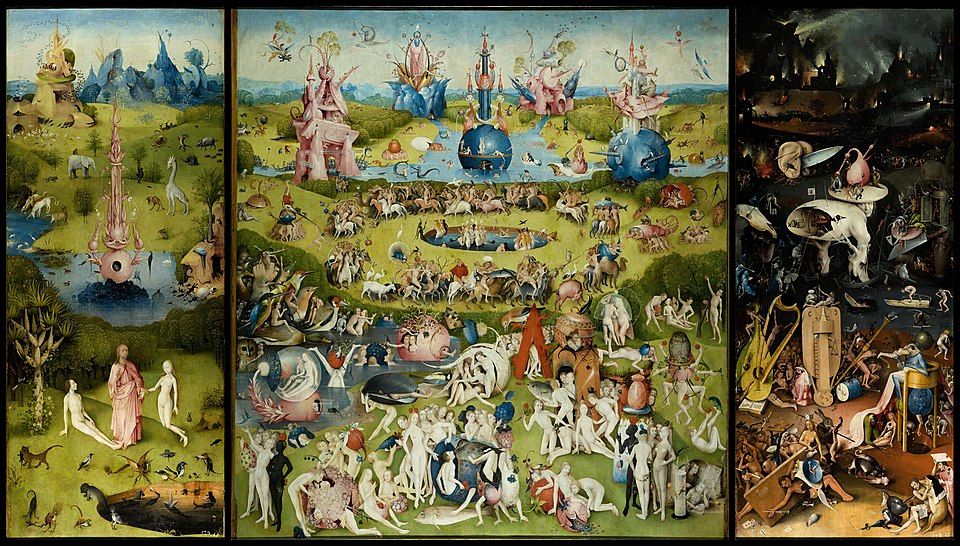
Hieronymus Bosch, The Garden of Earthly Delights, c.1490-1510. Public domain.
Three panels. Left: God presenting Eve to Adam in a landscape of impossible animals. Centre: hundreds of nude figures engaged in activities that are carnally joyful, absurd, and increasingly strange. Gigantic birds. Fruit used as architecture. Figures disappearing into fish. Right: a darkness full of burning buildings, instruments of torture, and figures in anguish. The scale is enormous. Every inch of every panel contains something new when you look closely enough.
The pentimento is in the structure. When the triptych is closed, the outer panels reveal the Earth as a transparent sphere floating in darkness: the world on the third day of creation, before the light, rendered in grey and green grisaille. You must open the panels to reach colour. The act of opening mirrors the act of entering the fallen world. Bosch designed the viewing sequence. The closed triptych is not a blank waiting state. It is the first image in a sequence of four.
Nobody knows who commissioned this painting. It was owned by Henry III of Nassau in 1517, but the commission and the original patron are undocumented. For a painting of this scale and ambition, the silence around its origin is itself remarkable. Bosch completed it, someone accepted it, and the reason it was made went unrecorded.
The butt music: In 2015, a student transcribed the notation painted onto a sinner's body in the hell panel. The piece is playable. It has been arranged for choir and performed.
The closed exterior: The grisaille panels showing Earth on the third day of creation may be by a different hand. The stylistic difference from the interior is significant enough to raise the question.
No known patron: Owned by Henry III of Nassau by 1517, but the original commission is undocumented. For a painting of this scale, that silence is extraordinary.
"You must open it to see the colour. The act of opening the triptych is the act of leaving paradise. Bosch designed the experience, not just the image."
The hell panel inverts the pleasures of the central panel into specific punishments. The vices are punished by their instruments. Gluttons are consumed. Those who indulged in music are tortured by it. A man is crucified on a harp. Another is trapped inside a lute. A figure walks through a crowd of sinners playing a hurdy-gurdy strapped to his abdomen. Bosch systematically converted every pleasure of the central panel into a device of suffering.
This painting is displayed in the permanent collection of a national museum that receives millions of visitors a year. It contains scenes that no contemporary publication would print without a content warning. Bosch painted them onto oak panels around 1500 and they have remained on public display, more or less continuously, for over five centuries.
- The music written on the body. In the hell panel, a figure lies face-down. On their body, in the curves of their flesh, music notation has been painted. Staff lines, notes, clefs. In 2015, a student at Oklahoma Christian University transcribed the notation and had it performed. The piece is a real piece of music. It has since been arranged for choir. Bosch painted a five-hundred-year-old song onto a sinner in hell.
- The bird-headed figure on the throne. In the lower right of the hell panel, a figure with a bird's head sits on a throne and eats sinners, then excretes them into a transparent pit below. This is a Bosch invention without a clear textual source. It is simply there, enormous and specific and disturbing, in one of the most visited museums in Europe.
- The closed exterior shows a different artist. The grisaille panels on the exterior are so different in style from the interior that some scholars have proposed they were painted by a different hand, or much later. The question is unresolved. The painting may contain multiple artists.
Museo del Prado collection and conservation database. Hyperallergic: "Excavating the Music Hidden in Bosch's Hell" (2015). Laurinda Dixon, Bosch (2003). Oklahoma Christian University transcription project.