Van Eyck
The Arnolfini Portrait
The mirror shows two figures who are not in the room. Above it, Van Eyck wrote "Johannes de Eyck fuit hic" - Jan van Eyck was here. A legal witness. A painting as a signed document.
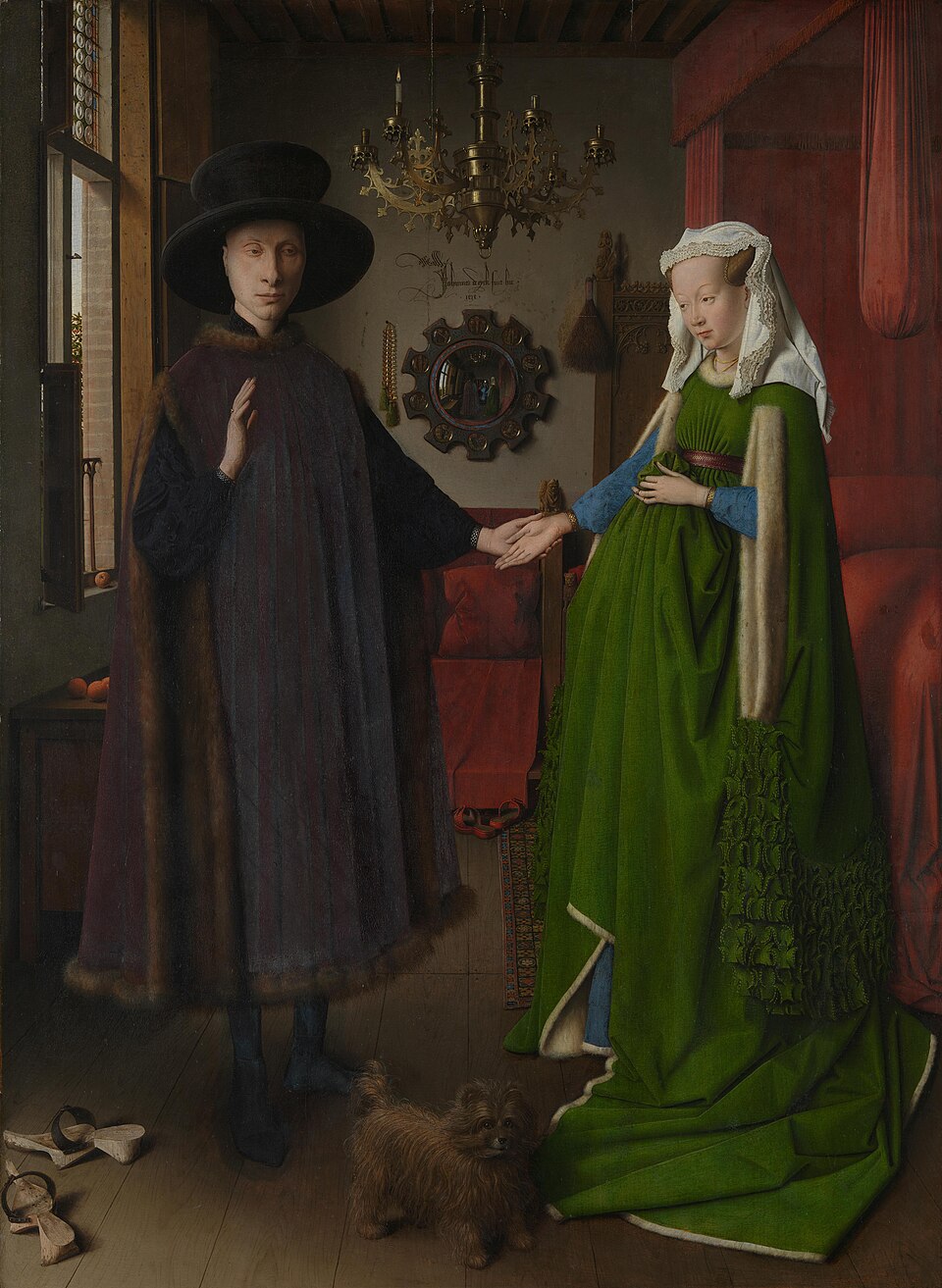
Jan van Eyck, The Arnolfini Portrait, 1434. Public domain.
A man and a woman stand in a private chamber. The panel is 82.2 by 60 centimeters, oil on oak - small enough to hold in your arms, though no one would have held it. He wears a tall hat of black felt and a houppelande - a voluminous tabard lined with what appears to be marten or sable fur, dark brown, the individual hairs visible where the garment falls open at the wrist. The fur alone would have cost more than a skilled craftsman earned in a year. She wears a dress of deep green wool with dagged sleeves lined in white fur, probably ermine. She gathers the fabric at her front in heavy folds, her left hand resting on the gathered cloth, her right placed lightly in his upturned left palm. He raises his right hand, palm outward, in a gesture whose meaning has never been settled - a greeting, a vow, a legal oath, a blessing. Or simply a man raising his hand because the painter told him to.
On the windowsill to the left, oranges. Three or four of them, depending on how you count the one partially hidden behind the casement. In Bruges in 1434, oranges were imported from the Iberian peninsula or further south at enormous expense. They did not grow in Flanders. They could not be preserved for long. They were perishable wealth, fruit that announced its own cost by its mere presence this far north. To place them casually on a windowsill was a display so pointed it was almost aggressive - the visual equivalent of lighting a cigar with a banknote.
But the oranges have also been read as symbols of fertility, as references to the golden apples of the Hesperides, and as a deliberate evocation of the Garden of Eden: paradise placed on the windowsill of a merchant's bedroom, where the light falls on them and they glow like small lamps. Van Eyck painted their skin with visible pores, with the slight irregularity and dimpled texture of real citrus, with a tonal shift between the side facing the window and the side in shadow. They are oranges. They may also be everything else. This is the central problem of the painting, and it starts at the windowsill: every object is so precisely rendered as a physical thing that it resists being read as a symbol, and yet the accumulation of objects is so deliberate that it demands symbolic reading. The painting holds both possibilities in suspension and refuses to resolve them.
The light in the room enters from the left, through a window whose shutters are partly open. It falls across the oranges, across the man's face and raised hand, across the green fabric of the woman's dress, and onto the floor between them. The light is cool and indirect - consistent with a north-facing window in the Low Countries, the kind of steady, diffused illumination that painters prize because it does not shift or change temperature over the course of a working day. Van Eyck rendered its behavior on every surface with absolute consistency. The highlights on the chandelier, the shadow under the bed, the reflection in the mirror, the sheen on the dog's coat - all respond to the same source, at the same angle, with the same intensity. The room is lit by one window, and every object in it knows where that window is.
Above the couple hangs a brass chandelier with six arms and space for six candles. Only one is lit - on the man's side, above his raised hand. The other five holders are empty. On the back wall, slightly left of center, hangs an amber rosary - ten beads and a tassel, the kind used for private devotion. Beside it, a small whisk brush. On the bedpost nearest the woman, a carved wooden figure: St. Margaret of Antioch, patron saint of childbirth, standing on the dragon she defeated. The bed itself is prominent, canopied, hung with red fabric. It dominates the right side of the painting. It is the largest single object in the room, and it is the color of blood, of ceremony, of the marriage bed.
At floor level, a small dog stands between the couple, looking directly at the viewer. It is a Brussels griffon - a toy breed, a luxury companion animal kept by the merchant class, not a working dog. It cost money to acquire and money to feed, and its only function was to be there, in the room, as a warm and expensive accessory. Behind the couple, on the far wall, a convex mirror. And on the floor, two pairs of shoes: his wooden pattens, outdoor overshoes with raised soles for walking through the mud and refuse of Bruges's streets, discarded near the lower left corner of the painting. Her red slippers, placed neatly by the bed on the opposite side. He has come from outside. She is at home. The distinction between outdoor and indoor footwear is itself a marker of wealth - this is a household where the floor is worth protecting and the street is worth keeping out.
The room itself may not exist. Or rather, it may not be a specific room that Van Eyck walked into and recorded. The tiled floor, the window, the chandelier, the bed - these could be assembled from separate observations, composited into a plausible interior that reads as real but was never occupied by these two people at the same time. Fifteenth-century painters routinely constructed settings from component studies. The room is convincing, but that is Van Eyck's argument, not his evidence. What is certain is that every object has been placed with deliberation so total that it has the quality of a sentence in a legal document. Nothing in this room is casual. Nothing is decorative. Everything has been argued over for a century, and nothing has been resolved.
The inscription above the mirror reads: "Johannes de Eyck fuit hic. 1434." Jan van Eyck was here. 1434. The Latin is precise and the phrasing is deliberate - written in an elaborate Gothic script, centered on the wall like a legal notation above a seal. Not pinxit, which means "painted this" and was the standard formula by which artists claimed authorship. Not fecit, which means "made this." Fuit hic - "was here." It is the language of a witness deposition, the phrase you would write on a legal document to certify that you were present when an act took place. If this painting records a ceremony - a marriage, a betrothal, a transfer of property - then Van Eyck is declaring himself present at it. He is not claiming the painting. He is claiming the room.
X-ray and infrared reflectography conducted by the National Gallery's conservation department have revealed that Van Eyck adjusted the positions of both figures' hands during painting. Giovanni's right hand - the raised one, the oath hand - was originally positioned lower. Van Eyck painted it, then changed his mind, moved it higher, and painted it again. The woman's left hand was also repositioned: the underdrawing shows it at a slightly different angle from the finished surface. The chandelier, too, was modified - the underdrawing shows alterations to the placement and curve of its arms. These are pentimenti in the strict technical sense: evidence of the artist thinking, revising, arriving at the final arrangement through a process of correction rather than executing a predetermined design.
The adjustments matter because they tell us something about how this painting was made. A painting copied from a preparatory cartoon - a common practice in fifteenth-century workshops - would show a clean underdrawing that matches the surface. The Arnolfini Portrait does not. The changes suggest that Van Eyck was working from life, arranging the figures in front of him, adjusting as he went. The couple may have stood in this room, in these clothes, while Van Eyck looked at them and decided where their hands should go. The painting may be, in the most literal sense, a record of a moment that was staged, adjusted, and then fixed in oil on oak.
There is also the question of what the infrared cannot resolve. The green dress shows no underdrawing at all in certain passages - Van Eyck appears to have painted sections of the fabric directly, without preliminary lines, building the folds through color and shadow alone. The dog, similarly, shows minimal preliminary work beneath it. Whether this means Van Eyck was supremely confident in these areas or whether certain pigments in the underlayers have become opaque to infrared imaging is debated. The painting keeps its own counsel.
The original frame, which survives intact, is also part of the painting in a way that later frames are not. It is an engaged frame - built as part of the panel construction, not applied afterwards. Van Eyck painted a faux marble pattern on the inner edge of the frame, a trompe l'oeil border that extends the illusion outward from the depicted room into the physical object. The frame is not a boundary between the painting and the world. It is a transition zone. Even the edge of this painting is designed to blur the line between what is real and what is represented.
Right hand: Repositioned higher from an earlier, lower placement. The underdrawing and finished surface do not match - the oath gesture was revised during painting.
Left hand: The woman's hand was adjusted in angle during painting. The original position is visible in infrared reflectography.
Chandelier: Alterations to the arms and their curvature, visible in the underdrawing layer. The final form differs from the initial layout.
Green dress: No underdrawing detected in several passages - painted directly in color without preliminary lines.
Inscription: Written in elaborate Gothic script, deliberately centered on the wall. Lettering consistent with legal document conventions of the Burgundian court.
Panel: Oak, 82.2 x 60 cm. Original engaged frame with painted marbling on the inner edge, integral to the panel construction.
Ground: Chalk and animal-skin glue, bright white, serving as the reflective base for Van Eyck's translucent glaze technique.
"We know who they are. We know when it was painted. We do not know what it is for. That is the most unsettling fact about the most studied painting in Northern European art."
In 1934, the art historian Erwin Panofsky published an article in the Burlington Magazine that established a reading of the Arnolfini Portrait so elegant, so comprehensive, and so satisfying that it was taught as established fact for the next fifty years. His argument was that every object in the painting functioned as what he called "disguised symbolism" - sacred meaning concealed beneath the surface of naturalistic depiction. The single lit candle was the all-seeing eye of God, bearing witness to the ceremony below. The removed shoes cited Exodus 3:5, where God commands Moses to take off his sandals because he stands on holy ground. The dog was fidelity - fides - the virtue that underpins marriage. The oranges were the fruits of paradise. The joined hands were the junctio dextrarum, the formal gesture of a marriage contract. The raised hand was the vow. The painting was not a portrait. It was a legal instrument: a pictorial marriage certificate, witnessed and signed by the painter on the wall.
Panofsky's reading was beautiful. It made the painting legible. It turned an image crowded with domestic objects into a theological document in which every detail carried weight. For decades, no alternative reading gained traction. The Arnolfini Portrait was, in Panofsky's account, the most fully explained painting in Northern Renaissance art - a work whose every surface had been decoded, whose every symbol had been translated. It appeared in textbooks. It was taught in survey courses. It was considered settled.
Then the identification of the sitters collapsed. The man had been identified as Giovanni di Nicolao Arnolfini, an Italian merchant from Lucca who lived and worked in Bruges. He was a factor - a commercial agent - for the Lucchese merchant community in the Burgundian Netherlands, a man of significant wealth and political connections, documented in the court records of Philip the Good. The woman was identified as his wife, Costanza Trenta. The problem, established by archival research that postdated Panofsky's article, is that Costanza Trenta died in 1433 - a year before the date inscribed on the painting.
If the woman in the painting was already dead when Van Eyck wrote "1434" above the mirror, this cannot be a record of their wedding. It cannot be a document of a ceremony that took place in this room with both parties present. The man may instead be a different Giovanni Arnolfini - Giovanni di Arrigo Arnolfini, a cousin, who married Giovanna Cenami in 1447, thirteen years after the painting's date. Or the painting may depict a betrothal rather than a marriage. Or a memorial to a dead wife - a portrait made to preserve the appearance and domestic setting of a woman who was no longer alive to inhabit it. Or a legal document whose specific terms we no longer have the cultural vocabulary to identify. Each of these readings is plausible. None has achieved consensus. The painting keeps generating hypotheses and consuming them.
Margaret Carroll challenged Panofsky directly in a 1993 article in Representations, arguing that the painting's legal character had more to do with property and male authority than with sacramental marriage. Her reading reframed the raised hand and the joined hands as gestures of legal possession rather than mutual vows - the painting documenting not a union of equals but a transfer of rights within the framework of mercantile law. Jan Baptist Bedaux proposed alternative symbolic frameworks that questioned whether the objects in the painting formed a coherent program at all, or whether scholars had imposed a system onto what was essentially a collection of domestic things painted with extraordinary care. In a 1986 article in Simiolus, he argued that the "reality of symbols" in Van Eyck was not what Panofsky had claimed - that some objects carried meaning and some did not, and that we could no longer tell which were which.
Craig Harbison argued that the relationship between naturalism and symbolism in early Netherlandish art was more fluid and less systematic than Panofsky's method assumed - that Van Eyck might have intended some objects symbolically and others literally, with no obligation to be consistent across the surface. Lorne Campbell, in his authoritative National Gallery catalogue, was careful to present the competing interpretations without endorsing any of them. The scholarly literature on the painting now runs to hundreds of articles, chapters, and monographs. Each one adds another reading. None displaces the others.
The painting went from being the most settled object in Northern Renaissance scholarship to one of the most contested. Nothing was added to the image. Nothing was taken away. Only the reading changed, and the painting became an entirely different object - not a solved puzzle but an open question, a room full of things whose meanings refuse to stay fixed. We know less about the Arnolfini Portrait now than scholars believed they knew in 1960. The uncertainty is not a failure of research. It is what the research produced.
- She is probably not pregnant. The gathered dress, held in voluminous folds at the front, was the fashion of the Burgundian court in the 1430s. Every woman Van Eyck painted holds fabric this way. The Lucca Madonna, the Virgin of Chancellor Rolin, St. Barbara in the van der Paele altarpiece - the same silhouette appears across his entire body of work. The visual cue that modern eyes read as pregnancy was simply how a fashionable woman stood. She is holding up the weight of an extremely heavy wool dress, pulling the excess fabric forward in a gesture that was both practical and stylish. Panofsky's fertility reading projected a twentieth-century assumption onto a medieval garment. The belly is fabric, not biology.
- The dog is a Brussels griffon - a status symbol, not an allegory. The standard reading since Panofsky has identified it as a symbol of marital fidelity. The revisionist reading points out that it is, more immediately, an indicator of disposable wealth. Brussels griffons were toy companion animals bred for the merchant aristocracy of the Low Countries. They served no working function. They hunted nothing, guarded nothing, herded nothing. They sat in laps and on cushions and cost money to acquire and maintain. Owning one said something specific about your position in the commercial hierarchy of Bruges. That the dog might also symbolize fidelity does not cancel the material fact: this is a painting full of expensive things, and the dog is one of them.
- The shoes tell two stories at once. His pattens - wooden overshoes with raised soles, designed to lift the wearer above the mud, manure, and waste of unpaved streets - are removed near the door, where a man coming from outside would drop them. Her red slippers sit by the bed on the far side of the room, where a woman already at home would leave them. The removal of shoes in Exodus signifies standing on holy ground. In a domestic context, it signifies nothing more than being indoors in a household wealthy enough to have clean floors and separate footwear. The gap between these readings - sacred versus domestic, symbolic versus material - is the gap that runs through the entire painting and has never been closed.
- The chandelier has one lit candle on his side and one extinguished socket on hers. This detail is central to the memorial reading of the painting. If Costanza Trenta died in 1433 and the painting was made in 1434, the single flame burning on the man's side and the empty socket on the woman's side could be a visual statement about the living and the dead. One flame still burns. One has gone out. This reading is speculative - it depends on the identification of the woman as Costanza, which is itself uncertain - but it has proven difficult to dismiss. The asymmetry is too deliberate, too visible, in a painting where nothing is accidental.
- The carved bedpost figure is St. Margaret of Antioch. She stands on the dragon she conquered, her hands clasped in prayer. Margaret was the patron saint of childbirth and of pregnant women. Her presence on the bedpost of a married couple's chamber is consistent with both the wedding reading and the memorial reading - she could be invoked as a blessing on future children or as a reminder of the dangers of childbirth that may have claimed the woman this painting commemorates. The carving is tiny. Most visitors to the National Gallery walk past it. Van Eyck did not.
- The amber rosary on the wall is not merely devotional. It is also, again, expensive. Amber beads imported to Flanders from the Baltic were luxury goods. The rosary hangs beside a small whisk brush - an object whose presence in the painting has never been satisfactorily explained. A symbol of domestic virtue? A cleaning tool left on a hook? An object that meant something in 1434 that we have simply lost? The painting is full of things like this: objects that resist interpretation not because they are mysterious but because the cultural context that would have made them obvious has evaporated.
- The green of her dress is still startlingly vivid after nearly six centuries. Van Eyck achieved this with copper resinate glazes over an opaque underlayer - a technique that in many other paintings has darkened to near-black over time. In the Arnolfini Portrait, the green has held. The dress reads today much as it would have read in 1434: a deep, saturated wool green, the color of money, of spring, of the natural world brought indoors. Whether this survival is due to Van Eyck's superior formulation of the glaze, to favorable storage conditions across the centuries, or to some combination of both, the result is a color that still commands the painting. The green dress is the largest continuous area of bright color in the composition. It anchors the woman in the center of the image. It is the thing your eye goes to first, before the mirror, before the chandelier, before the inscription. Six hundred years later, Van Eyck's green is still doing its job.
The convex mirror on the back wall is five and a half centimeters in diameter on the panel's surface. Within that circle, Van Eyck painted the entire room in reverse: the backs of both figures, the window with its light streaming in, the red canopy of the bed, the tiled floor, and - crucially - two figures standing in the doorway, facing the couple. These are not the Arnolfinis seen from behind. These are two additional people, entering or witnessing, occupying the space between the couple and the viewer. One of them may be Van Eyck himself. The inscription above the mirror, declaring that he was here, would support this. The painter placed himself inside his own painting - not on its surface, not as a figure in the room, but in a reflection five and a half centimeters wide.
Around the mirror's frame, ten roundels depict scenes from the Passion of Christ. Each roundel is approximately the size of a peppercorn on the panel. Within each, Van Eyck painted recognizable figures, architectural settings, and narrative action: Christ in Gethsemane, the Betrayal, Christ before Pilate, the Flagellation, the Carrying of the Cross, the Crucifixion, the Deposition, the Entombment, the Harrowing of Hell, the Resurrection. Ten scenes. Ten peppercorns. The entire arc of Christ's suffering and triumph, painted around the frame of a mirror that reflects a merchant's bedroom in Bruges. This was not technically necessary. No patron required it. No viewer standing at a normal distance from the painting in 1434 could have seen these details without a magnifying instrument. Van Eyck painted them because the painting demanded of itself a completeness that exceeded practical observation. He was not painting for the viewer. He was painting for the painting.
The mirror also creates a spatial paradox that would not be formally theorized for another four centuries. It shows the room from the viewpoint of someone standing where the viewer of the painting stands - that is, it reflects back the act of looking. The two figures in the doorway, visible only in the reflection, occupy our space. They are standing where we are standing. Van Eyck built into the painting an acknowledgment that it has an audience, that someone is looking, that the room extends beyond the frame and into the space of the gallery. Velazquez would do the same thing in Las Meninas in 1656, using a mirror to include the Spanish king and queen in the painting's space. That painting is celebrated as a revolution in the philosophy of representation. Van Eyck did it 222 years earlier, in a circle the size of a coin, in a merchant's bedroom in Bruges.
The mirror also functions as a theological device, whether or not Van Eyck intended it as one. It shows what the painting cannot show: the space behind the viewer, the doorway, the world outside the frame. A painting is a single viewpoint, locked in place. The mirror breaks that lock. It reveals the room's other half, the part the viewer occupies but cannot see. In theological terms, this is the function of the speculum sine macula - the mirror without stain, a symbol of the Virgin Mary and of divine purity, a surface that reflects truth without distortion. Convex mirrors were also called "witch's eyes" and "sorcerer's mirrors" in the fifteenth century. They were objects of fascination and unease - tools that bent the world into a sphere, that showed more of reality than the naked eye could take in at once. Van Eyck placed one at the center of his painting, made it the literal focal point of the composition, and painted inside it more detail than any other five-centimeter circle in the history of art.
Whether this is divine omniscience or optical trickery - or whether Van Eyck understood those as the same thing - is a question the painting poses without answering. What the mirror does, practically, is make the painting impossible to exhaust. You can look at the figures. You can look at the room. You can look at the mirror and see the room again, differently, from the other side. You can look at the Passion roundels and find narrative within the frame of the mirror itself. The painting folds inward. It contains more than its surface area should allow. This is Van Eyck's deepest argument: that a painting eighty-two centimeters tall can hold a world, and that the world it holds can include the person looking at it.
Erwin Panofsky's 1934 article in the Burlington Magazine established a reading of the Arnolfini Portrait that was so elegant, so comprehensive, and so intellectually satisfying that it was treated as definitive for half a century. His method - which he called "disguised symbolism" - proposed that every object in an early Netherlandish painting carried a hidden sacred meaning beneath its naturalistic surface. The painter depicted the world with unprecedented fidelity to visual reality, but that reality was itself a code. The dog was fides, marital fidelity. The single burning candle was the all-seeing eye of God, the divine witness to the sacrament below. The fruit on the windowsill was Eden, the unfallen world invoked as a blessing on the marriage. The removed shoes were Exodus 3:5, God commanding Moses to stand barefoot on holy ground. The joined hands were the legal gesture of the marriage contract. The raised palm was the oath. The painting was a document - a pictorial certificate, signed on the wall by the painter in his capacity as witness. Every surface decoded. Every object translated. The painting solved.
The reading was beautiful. It was also, as subsequent scholars demonstrated, either wrong or - more damagingly - unprovable. The first crack was biographical. If Costanza Trenta died in 1433, the painting dated 1434 cannot record her wedding. Panofsky's entire framework depended on the painting being a legal record of a marriage ceremony witnessed by Van Eyck. Remove the marriage and the inscription "fuit hic" ceases to be a witness statement. It becomes simply a declaration of presence - a painter saying he was in a room, without specifying what happened there. The most famous phrase in Northern Renaissance art becomes, under scrutiny, a sentence that tells us almost nothing.
The second and more fundamental problem was the method itself. Margaret Carroll, Jan Baptist Bedaux, and others pointed out that "disguised symbolism" is unfalsifiable. Once you decide that every object in a painting carries a hidden meaning, any interpretation can be justified and none can be disproven. A dog is fidelity - or it is a dog. A candle is the eye of God - or it is a source of light in a room. The oranges are paradise - or they are oranges, placed on a windowsill because that is where fruit is kept, in the light, where it will not rot. Panofsky's method could not distinguish between a painting that was systematically encoded with theological symbols and a painting that simply depicted a well-furnished room with extraordinary accuracy. The distance between those two possibilities - between a sacred code and an inventory of beautiful things - is the distance the painting has traveled since 1934.
What survived the collapse was something more interesting than the reading it replaced. The painting became genuinely unknown. For fifty years, scholars had agreed on what it meant. After Carroll and Bedaux, no one did. The same objects sit in the same room, painted with the same impossible precision, and their meaning is open in a way that Panofsky's certainty had foreclosed. The dog has not changed. The candle has not changed. The oranges have not moved. But the painting is a fundamentally different object when its symbols are locked than when they are floating - when every detail is pinned to a theological referent versus when every detail might mean anything, or nothing, or something we no longer have the language to recover.
There is an irony in this that Panofsky himself might have appreciated. His method was designed to recover lost meaning - to reconstruct the symbolic language that fifteenth-century viewers would have understood instinctively and that modern viewers had forgotten. The method worked brilliantly for some paintings. Applied to the Arnolfini Portrait, it produced a reading so persuasive that it seemed to solve the painting permanently. But the biographical evidence dissolved the solution, and what was left was not a return to the pre-Panofsky state of simple admiration. What was left was a painting that had been taken apart and could not be reassembled. The painting did not change. The framework for understanding it fell away, and what remained was larger than the explanation had ever been.
Van Eyck's oil technique was so advanced that Giorgio Vasari, writing more than a century later in his Lives of the Artists, credited him with the invention of oil painting itself. This was wrong - oil had been used as a binding medium before Van Eyck, and the recipes appear in treatises predating his career - but the error is understandable. What Van Eyck did with oil was so far beyond anything his contemporaries or predecessors achieved that it appeared to be a different medium entirely. He did not invent the material. He invented what the material could do.
The distinction matters technically. Before Van Eyck, most Northern European panel painting used egg tempera - pigment bound with egg yolk, which dries fast, handles cleanly, and produces a matte, opaque surface. Tempera is worked in small, precise strokes, hatched and cross-hatched to build form and tone. It does not blend on the surface. It does not layer transparently. It sits where you put it. The visual effect is clear, bright, and flat - suited to the gold-ground devotional panels and manuscript illumination that preceded Van Eyck's generation.
Oil, by contrast, dries slowly enough to be manipulated while wet. It can be thinned to near-transparency and applied in successive films - glazes - that allow light to pass through the pigment, strike the white ground beneath, and reflect back through the color. The effect is luminosity that opaque paint cannot achieve: the painting appears to glow from within, as though lit from behind its own surface. Van Eyck understood this physics intuitively and exploited it with a sophistication that his contemporaries could not replicate. The painters who came after him - Rogier van der Weyden, Hans Memling, Gerard David - learned from his technique but never matched the depth of his glazes or the precision of his optical effects.
The Arnolfini Portrait is painted on an oak panel prepared with a bright white ground of chalk and animal-skin glue. Over this ground, Van Eyck applied successive layers of these translucent glazes, each one modifying the color temperature and depth of the one beneath it. This is what makes the brass chandelier look like actual polished metal - the reflections are built from layered yellows, browns, and whites that interact with the ground to produce a warmth no single pigment could deliver. It is what gives the red bed hangings their extraordinary depth, the color seeming to recede into the fabric rather than sitting on its surface. It is what makes the convex mirror appear to be a real reflective object rather than paint on wood. Van Eyck was not depicting light. He was engineering it, using the physics of translucent media over a reflective ground to produce actual optical effects on the panel's surface.
The brass chandelier reportedly required three days of sustained work. Each arm is modeled individually, with highlights that are consistent with a light source at the window - the reflections fall where they would fall on polished metal in that specific room, with that specific light, at that specific angle. The fur lining of Giovanni's houppelande is built from individual hairs, laid one at a time in layers of transparent brown and black glaze, each hair catching light differently depending on its angle. The wooden pattens on the floor show individual grain patterns in the oak. The oranges on the windowsill have visible pores in their skin and a subtle variation in surface texture between the sun-facing and shadow-facing sides. The beads of the amber rosary are distinguishable from one another, each with its own highlight and its own weight. Technical analysis of the paint layers indicates that Van Eyck sometimes used single-hair brushes for the finest passages - tools that allowed him to place detail at a scale that exceeds what the unaided eye can comfortably resolve.
This level of detail is not decoration. It is not virtuosity for its own sake, though it is certainly that as well. It is an argument about what painting can be. Van Eyck was proposing that the art could achieve a descriptive completeness that rivaled the visible world itself - that every surface, every texture, every accident of light on material could be captured, preserved, and made permanent on a piece of oak. No painter before him had attempted this. No painter for generations after would match it. The Arnolfini Portrait is not admired for its composition or its emotional depth or its narrative power - it is admired for its sheer density of observed reality, for the quantity of visible truth compressed into a surface smaller than a modern laptop screen.
He painted beyond the threshold of normal vision. The Passion roundels on the mirror frame, the individual hairs in the fur, the grain of the pattens, the pores of the oranges - these details can only be fully appreciated under magnification. No viewer standing at a normal distance from the painting in 1434 could have seen them. Van Eyck placed them there not for any patron's benefit, not for the market, not for posterity's microscopes, but because the painting, as a complete account of a room, required them to exist.
He saw more than almost anyone has seen before or since. And he recorded what he saw with a fidelity so total that it amounts to a kind of devotion - not to God, though perhaps that too, but to the visible world and to the conviction that it deserved to be preserved exactly as it was. The Arnolfini Portrait is sometimes described as a technical achievement, as though its primary significance were the skill required to produce it. This undersells it. What Van Eyck achieved was not merely technical mastery but a philosophical position: that the physical world, observed closely enough and rendered faithfully enough, would reveal its own meaning. That every surface, every texture, every play of light on brass or fur or orange skin contained, within itself, enough truth to justify the labor of recording it. Whether the painting also contains a hidden symbolic program is, in a sense, beside the point. The surfaces alone are sufficient. They were always sufficient. Van Eyck made them so.
The painting entered the English royal collection sometime in the sixteenth century, possibly as a diplomatic gift, possibly as spoil. Its provenance before that is patchy but suggestive. It appears in a 1516 inventory of Margaret of Austria's collection in Mechelen, where it is described as a large painting depicting "Hernoul le Fin" and his wife - evidence that the identity of the sitters was still known, at least approximately, eighty years after it was painted. How it passed from the Arnolfini family to Margaret of Austria is not recorded. How it passed from England to Spain and back again during the Napoleonic Wars is documented but tangled. By 1842 it was in the National Gallery in London, acquired by the museum for an undisclosed sum. It has hung there ever since - first as a curiosity of early Netherlandish craftsmanship, then as Panofsky's decoded document, then as the enigma it remains today.
Its journey across five centuries, four countries, and innumerable interpretive frameworks has not clarified it. Each new owner saw a different painting. Margaret of Austria saw a portrait of a merchant and his wife. The Spanish Habsburgs saw Flemish virtuosity. The National Gallery saw a masterpiece of technique. Panofsky saw a theological code. Post-Panofsky scholars saw the ruins of a theological code. Visitors today see a man, a woman, a room, a mirror, and a set of questions that have no answers. The painting absorbs each reading without being changed by it. It was the same object before Panofsky and it is the same object now. Only we are different.
What we have is a painting that refuses to become a single thing. It is a portrait, but we are not entirely certain of whom. It is a document, but we cannot read its terms. It is full of symbols, but the key to the code - if there was a code - has been lost, and the attempt to reconstruct it proved more revealing of twentieth-century scholarship than of fifteenth-century Bruges. The mirror reflects a room that may not exist. The inscription declares a presence at an event that may not have been an event. The candle burns on one side and not the other, and the reason may be theological, or memorial, or practical, or nothing at all.
The painting is now the most visited single object at the National Gallery. Visitors stand in front of it and lean in to see the mirror, the chandelier, the dog, the inscription. They see an extraordinary record of a room. They see two people whose identities are debated, whose relationship is uncertain, whose reason for standing in this room on this day in 1434 is unknown. They see a painting that, after nearly six centuries of scholarship, conservation, infrared scanning, X-ray analysis, art-historical argument, and popular reproduction, remains exactly as unresolved as it was the day Van Eyck put down his brush.
Van Eyck gave us everything. He painted every hair on the fur, every pore on the oranges, every reflection on the chandelier, every bead on the rosary, every scene from the Passion on ten roundels the size of peppercorns around a mirror five and a half centimeters wide. He painted more of the visible world into eighty-two centimeters of oak than anyone had ever painted before. He made a painting so detailed that six centuries of increasingly sophisticated technical analysis have not exhausted its surfaces. And then he wrote on the wall, in Gothic script, that he was here.
He told us he was present. He told us the year. He told us nothing else. The most completely described room in fifteenth-century art is also the least understood. Every object is visible. Every texture is legible. The light is consistent. The space is plausible. The faces are specific enough to be portraits. The clothing is accurate enough to be dated. And none of it adds up to a statement we can read with confidence. The painting gives us everything except the one thing we want, which is to know what we are looking at. That gap - between total visual information and total interpretive uncertainty - is what makes the Arnolfini Portrait inexhaustible. It is finished. It is complete. It is, nearly six hundred years later, unresolved.
National Gallery, London: collection catalogue entries, conservation records, and infrared reflectography / X-ray analysis of the Arnolfini Portrait. Accessed via the National Gallery Technical Bulletin and online collection database.
Panofsky, Erwin. "Jan van Eyck's Arnolfini Portrait." Burlington Magazine 64, no. 372 (March 1934): 117-127.
Carroll, Margaret D. "In the Name of God and Profit: Jan van Eyck's Arnolfini Portrait." Representations 44 (Autumn 1993): 96-132.
Campbell, Lorne. The Fifteenth Century Netherlandish Schools. National Gallery Catalogues. London: National Gallery Publications, 1998.
Harbison, Craig. Jan van Eyck: The Play of Realism. 2nd ed. London: Reaktion Books, 2012.
Bedaux, Jan Baptist. "The Reality of Symbols: The Question of Disguised Symbolism in Jan van Eyck's Arnolfini Portrait." Simiolus 16, no. 1 (1986): 5-28.