Manet
Olympia
She is looking at you. Not past you, not through you. At you. In 1865, that was enough to nearly destroy a career and rewrite the rules of European painting.
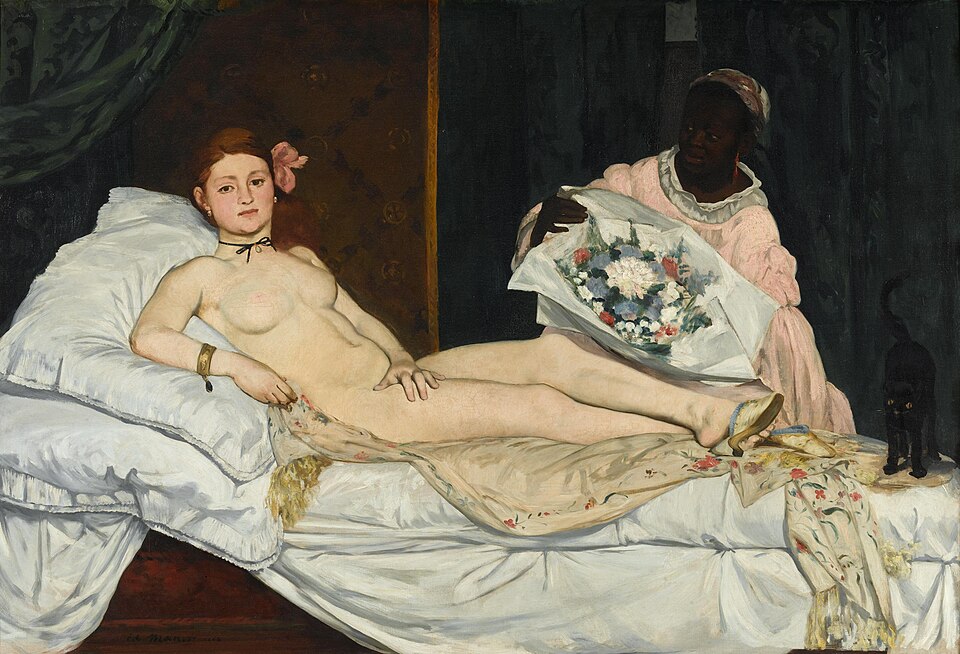
Edouard Manet, Olympia, 1863. Public domain.
A woman reclines on a bed, propped on pillows, her body turned toward you. She is nude. Victorine Meurent - that is the model's name, and she has one - stares directly at the viewer with an expression that is neither inviting nor hostile. It is transactional. Flat. She knows what this is.
Her body is pale, lit from the front with an almost clinical directness that eliminates the soft tonal gradations academic painters used to make flesh appear to breathe. There is no warmth in this light. It is the light of inspection, not intimacy. It flattens her torso into a nearly uniform plane of pale skin against white linen, with only the faintest modeling to suggest the body beneath.
The light source is not atmospheric - there is no golden Venetian glow, no soft northern studio illumination. It is direct, frontal, and unforgiving, the kind of light that reveals rather than flatters. Academic painters spent their careers learning to light the female body in ways that made it appear to glow, to breathe, to invite. Manet lit Olympia the way a photographer lights a subject for documentation: evenly, without romance, with the single purpose of making everything visible. The result is a body that looks like a body rather than a fantasy of one.
The bed she lies on is not a mythological prop. It is linen and pillows, rumpled, used, specific. The sheets are white but not pristine - they are the sheets of a bed that has been slept in, that has a daily life, that belongs to a real room in a real building in Paris. The pillows behind her are propped to support a reclining body, not arranged for a painter's composition. Everything about the setting says: this is a place where a person lives and works. The large cashmere shawl draped beneath her is an expensive import, the kind of furnishing that locates this room in the demi-monde rather than in poverty. These are not cheap lodgings. This is a professional space.
Her left hand is placed firmly on her thigh. Not draped loosely, not resting in soft modesty the way four centuries of reclining nudes had required. The hand is pressed down, fingers together, a deliberate act of covering that is simultaneously a refusal to perform the fiction that she is not being looked at. Contrast this with Titian's Venus of Urbino, whose left hand lies between her thighs with the gentle, distracted ease of a woman who does not know she has an audience. Olympia knows. Her hand says so. It is a gate, not a gesture. It acknowledges the viewer's desire by blocking it, and that acknowledgment is what made the painting unbearable to its first audience.
She wears an orchid in her hair - a flower associated with sexuality, expensive, hothouse-grown, the kind of ornament a woman of the demi-monde would wear for a particular evening. A black ribbon choker is tied around her neck, a marker recognized instantly by every Salon visitor in 1865 as an accessory associated with prostitutes in Paris. The choker was not a subtle signal. It was a known sign, as legible as a uniform. It divided her head from her body with a thin black line, a visual separation that several critics noticed and that reads, at a distance, almost like a cut - as though the head and the body were separate propositions, the face doing one thing (looking, thinking, assessing) and the body doing another (being displayed, being available, being priced).
A gold bracelet with a pendant catches the light on her right wrist. A single mule slipper dangles from her right foot, the other foot bare. The slipper is important: it is the kind of detail that locates the scene not in myth but in a specific room, a specific afternoon, a specific transaction about to begin or just concluded. A goddess does not wear slippers. A goddess does not kick one off. Every accessory in the painting is a refusal of abstraction - a small, concrete, specific object that anchors the scene in the real Paris of the 1860s rather than in the timeless nowhere of classical mythology.
Behind her, the servant - a Black woman in a white dress and a pink headwrap - presents a large bouquet of flowers wrapped in paper. The flowers are from a client. They are a delivery, not a decoration. The servant holds them forward with a kind of professional patience, waiting for a response. She is not a background element. She is the second actor in a two-person scene, and her presence turns the painting from a study of a nude into a narrative - a story with a before and an after, a sender and a recipient, a question that has not yet been answered.
At the foot of the bed, a black cat stands with its back arched and its tail raised, staring out at the viewer with the same directness as the woman it accompanies. The cat is a replacement. Titian's Venus of Urbino has a small sleeping dog curled at the foot of the bed, a symbol of fidelity and domestic loyalty. The dog sleeps because the scene is safe, sanctioned, marital. The cat arches because this scene is none of those things.
In Parisian slang and visual culture of the 1860s, the cat carried associations of nocturnal sexuality, independence, the streets. It was the animal of the night, of rooftops and alleys, of a world that operated after the respectable world went to sleep. The word chatte carried vulgar double meanings that every viewer at the Salon would have understood. The cat's arched back and raised tail are aggressive postures - not the docile, decorative presence of a pet but the bristling alertness of an animal that lives by its own rules. Its eyes, like Olympia's, are directed at the viewer. Two gazes from the same painting, both refusing to look away.
The canvas measures 130.5 by 190 centimeters. It is not a small painting. It was built to confront at life scale. Olympia's body is nearly the size of a real woman's body. The viewer standing in front of it at the 1865 Salon would have been face to face with a figure the same size as the actual women they passed on the boulevards of Paris. The painting did not miniaturize or distance its subject. It presented her at the scale of encounter.
The pentimento here is not hidden beneath the paint. It is structural. The entire painting is a revision of Titian's Venus of Urbino (1538) - not a quotation, not an homage, but a systematic inversion executed point by point with the precision of an argument. Manet took the most celebrated reclining nude in European painting and repainted it with every mythological alibi stripped away.
He had studied the Venus in person. He traveled to Florence in 1853, stood in front of it in the Uffizi, and made pencil sketches in a notebook that survives. He wrote to a friend that the Venus of Urbino was "the most beautiful picture that has ever been painted." He was not being dismissive. He admired the painting deeply.
What he did to it a decade later was not contempt. It was the opposite - it was the most serious form of engagement a painter can offer another painter's work. He took the composition apart, examined each element, understood what each element was doing, and then reassembled the whole with each element performing the opposite function. This is not parody. Parody mocks its source. Manet honored his source by taking it seriously enough to argue with it. He understood the Venus of Urbino better than most of its admirers because he understood what the painting was doing beneath its beautiful surface. The relationship between the two works is not art-historical inference. It is documented in Manet's own hand.
The inversions are systematic and exhaustive. Every element in Titian's composition has a corresponding element in Manet's, and every correspondence is a reversal.
Where Titian has a goddess, Manet has a sex worker. Where Titian places a sleeping lapdog at Venus's feet - a symbol of marital fidelity and domestic warmth - Manet places an arched black cat, alert and bristling, an emblem of nocturnal sexuality and the Parisian demi-monde. Where Titian's Venus gazes at the viewer with serene, permissive warmth - an invitation wrapped in mythology - Olympia gazes with the flat clarity of a commercial transaction.
She is not available. She is for sale. There is a difference, and Manet painted it. The distinction matters because it is the hinge of the entire painting. Availability implies generosity, willingness, a gift freely given. Sale implies a price, a negotiation, terms. Titian's Venus offers herself. Olympia names a rate. The gesture looks the same - a reclining woman, a direct gaze - but the underlying structure has been reversed. One is fantasy. The other is economics.
Where Titian used warm Venetian tonality - golden glazes, a body that seems to glow from within its own skin, colors that recede into atmospheric depth - Manet used flat, confrontational front-lighting that makes Olympia's body look like a surface rather than a volume. The skin does not recede into shadow. It sits on the canvas, two-dimensional and unapologetic. The modeling that academic painting required - the slow graduation from highlight to halftone to reflected light to shadow that made a painted body appear to occupy three-dimensional space - is largely absent. Olympia's torso is almost a silhouette, a pale shape with hard edges, closer to a Japanese print than to a Renaissance oil.
Where Titian's background shows two servants rummaging through a marriage chest in a deep, architecturally rendered interior - domesticity, legitimacy, the household as institution, space receding into the reassuring depth of a home - Manet's background is a wall of dark green and heavy curtain, flattened, closing off all depth. There is no domestic interior to retreat into. There is no distance. There is no depth into which the eye can escape from the confrontation at the surface.
There is only the bed, the woman, the servant with the flowers, and you. The compression of space is part of the argument. Academic painting gave you room to breathe - corridors, windows, landscapes receding to a vanishing point, the reassuring illusion that the scene extended beyond the frame. Manet took that space away. The background is a wall. The frame is a cage. The viewer is locked in with Olympia, and she is not letting anyone pretend that the room is larger than it is.
The woman: Titian's Venus is a goddess. Olympia is a courtesan. The title itself was slang for a sex worker in 1860s Paris.
The hand: Venus's left hand rests loosely, dreamily, between her thighs. Olympia's is pressed flat, fingers together - a barrier, not a caress.
The animal: Venus's small dog sleeps at her feet (fidelity, domesticity). Olympia's black cat arches its back (sexuality, the streets, the night).
The gaze: Venus looks at the viewer with warm invitation. Olympia looks with the flat recognition of a transaction.
The background: Titian paints a deep domestic interior with servants and a marriage chest. Manet closes the space to a dark wall. No depth, no escape, no context beyond the bed.
The light: Venetian warmth and golden glazing vs. flat, frontal illumination that eliminates atmosphere.
The flowers: No equivalent in Titian. The bouquet is Manet's addition - the element that turns the scene from a timeless nude into a specific moment in a transaction. Someone sent these. Someone is waiting for an answer.
The slipper: Venus of Urbino is barefoot - she is in her own home, at ease. Olympia wears one mule slipper and has kicked off the other. She is between states: not yet undressed, not yet dressed. The scene is in progress.
This is what makes Olympia a structural pentimento rather than a painted-over revision. The earlier painting is not beneath the surface. It is inside the composition, visible to anyone who knows the Venus of Urbino - which in 1865 was every educated person who walked into the Salon. The Uffizi painting was one of the most reproduced images in European art. Students copied it. Engravers circulated it. The composition was as familiar as a proverb.
Manet did not hide his source. He displayed it. He wanted you to see both paintings at once - the goddess and the sex worker, the myth and the transaction, the sleeping dog and the arched cat - and to understand that they had always been the same painting. One simply told the truth about it. The structural pentimento operates not by concealment but by revelation. It does not paint over the previous image. It places the previous image next to the new one and lets the viewer see the distance between them. And the distance between Venus and Olympia is the distance between a lie that everyone agrees to believe and a truth that no one can tolerate hearing.
"She is not beautiful. She is not ugly. She is present. That was enough to threaten everything European painting had spent four centuries building."
Manet painted Olympia in 1863 but did not submit it to the Salon until 1865. He knew what he had. He may also have known what would happen.
Friends advised him against submitting it. Charles Baudelaire, who admired Manet's work and championed it in private, understood the risk. The painting sat in Manet's studio for two years while he considered whether to expose it to the Salon jury and the Salon public. Two years is a long time to hold a finished painting back. It suggests calculation, or anxiety, or both.
This was not his first scandal. Two years earlier, his Le Dejeuner sur l'herbe had been exhibited at the Salon des Refuses - the exhibition organized by Napoleon III for works rejected by the official jury - and had provoked outrage for depicting a nude woman seated on the grass between two fully clothed men in modern dress. The nudity was not the problem. The modernity was. The men were wearing suits. The woman was not wearing anything. There was no mythological pretext, no classical alibi, no nymphs or goddesses to make the scene acceptable.
It was a picnic with a naked woman in it, and Paris did not know what to do with it. Olympia was the same confrontation, escalated. If Le Dejeuner placed a nude in an implausible modern setting, Olympia placed a nude in a plausible one - a courtesan's bedroom, a working space, a room where the transaction the painting depicted actually took place every day across the city.
When Olympia was exhibited at the 1865 Salon, the response was immediate, physical, and extreme. Critics reached for the language of disgust. Amedee Cantaloube called her "a female gorilla." Jules Claretie compared her body to rotting flesh. Another critic described her as "a sort of female gorilla made of India rubber." Ernest Chesneau wrote that the painting inspired "an almost childish desire to laugh." Victor de Jankovitz said the color of the flesh was dirty. They said the painting looked like a playing card - flat and unfinished, the work of someone who either could not paint or was deliberately mocking the Salon and everyone in it.
The abuse was not limited to the press. Crowds gathered in front of the painting not to admire but to jeer. Visitors tried to attack the canvas with their umbrellas and walking sticks. Caricaturists produced dozens of satirical drawings - Olympia reimagined as a skeleton, as an ape, as a coal miner's wife, as anything other than what she was. The caricatures are revealing because they show what the public found intolerable: almost all of them alter or eliminate the gaze. The satirists drew the body. They could not bring themselves to reproduce the eyes.
The Salon administration was forced to act. They rehung the painting - moving it high up, near the ceiling, where viewers could barely see it. Guards were posted to prevent further assaults on the canvas. The Salon kept it on display. They could have removed it. That they did not is itself an act whose motivations remain ambiguous - principle, or the commercial value of scandal. What is certain is that no painting at the 1865 Salon attracted more visitors, more column inches, more physical rage than Olympia. It became the thing you went to the Salon to see, even if - especially if - you went to express your contempt.
The critical language is worth examining because it reveals what was actually at stake. The repeated comparison to animals - gorilla, rubber - was not random invective. It was a specific denial of humanity. If Olympia could be made subhuman, then her gaze could be dismissed as something other than consciousness. If she was a gorilla, she was not looking at you with the knowing awareness of a person who understands the transaction. She was just an animal staring blankly.
The critics needed her to be less than human because a human woman looking at them with that expression was intolerable. The violence of the language was proportional to the threat of the gaze. It is also worth noting that the same critics who compared Olympia to a gorilla had no objection to Cabanel's nude, which was more explicitly sexual in pose and equally detailed in its depiction of the female body. The difference was not in what was shown. It was in the consciousness behind the eyes. An unconscious nude was erotic. A conscious one was obscene.
Emile Zola was among the very few who defended the painting publicly and without qualification. He wrote that Manet's eye was honest, that the painter had simply seen a woman and painted her as she was, and that the outrage said more about the hypocrisy of Paris than about anything on the canvas. Zola published his defense in 1867, in a pamphlet-length essay that argued Manet's importance to the future of French painting. The essay cost Zola professionally - defending Manet was not a neutral act in the 1860s, and Zola accepted the consequences deliberately.
Zola understood what most of the critics would not admit: the Salon was full of nudes. Cabanel's Birth of Venus, exhibited two years earlier to universal praise and purchased by Napoleon III himself, depicted a nude woman in a pose far more explicitly sexual than Olympia's. But Cabanel's Venus was a goddess. She was wrapped in sea foam and mythology. Her eyes were closed. She did not look at anyone. Bouguereau's nymphs and Gerome's slave markets offered nudity that was equally explicit and equally acceptable, because it came with a mythological or Orientalist frame that allowed the viewer to pretend the pleasure was intellectual rather than physical. The scandal of Olympia was never the nudity. It was the refusal to mythologize.
The model, Victorine Meurent, was not a passive subject. She was a painter herself - a fact that has only recently been recovered by art historians. She exhibited her own work at the Paris Salon in 1876, the same year Manet himself was rejected by the jury. She played the guitar. She gave music lessons. She had modeled for Manet before, including for Le Dejeuner sur l'herbe, and she would model for him again.
Meurent lived until 1927, surviving Manet by forty-four years. She saw the painting go from scandal to icon. She saw it purchased by public subscription in 1890 - organized by Claude Monet, who raised the funds from private donors and wrote personal letters to collectors soliciting contributions - and donated to the Musee du Luxembourg. It was transferred to the Louvre in 1907, and eventually to the Musee d'Orsay when that museum opened in 1986.
Meurent outlived every critic who had compared her to a gorilla. She outlived Manet, who died at fifty-one from complications of syphilis and a gangrenous leg. She outlived the scandal, which calcified into art history, which calcified into reverence. In her later years she lived in poverty and obscurity, her own painting career largely forgotten.
The woman who sat for the most notorious painting in the history of the Paris Salon was, in her own right, an artist who outlived the painter who made her famous and whose own career has been recovered only in recent decades by scholars willing to look past the canvas she appeared on. Like Laure, Meurent was reduced by art history to her function in someone else's painting. Like Laure, she has been partially recovered. The painting contains at least two erasures: the servant made invisible by criticism, and the model made invisible by fame.
- The bouquet is the key to the entire scene. The flowers are not decorative. They are not a compositional flourish. They are being delivered - wrapped in paper, still fresh, a gift from a man who is not in the painting but whose presence is implied by the transaction the flowers represent. The servant holds them up for Olympia's consideration. Olympia has not yet decided whether to acknowledge them. The scene Manet has painted is not a nude at rest. It is a specific moment in a specific business arrangement: the client has sent flowers, the servant is presenting them, and the woman on the bed is deciding what to do about it.
- The flatness was as shocking as the subject. Manet used minimal tonal modeling on Olympia's body - hard outlines, broad areas of unmodulated color, almost no transition between light and shadow on the torso. Critics said it looked like a playing card, like a cutout pasted onto the canvas. This was not incompetence. It was a conscious stylistic choice influenced by Japanese ukiyo-e woodblock prints, which Manet and his circle had been collecting throughout the early 1860s. The hard outlines, the compressed tonal range, the emphasis on surface over depth - all hallmarks of ukiyo-e, transplanted onto a monumental European oil painting.
- The name was a provocation. "Olympia" was widely recognized slang for a courtesan in mid-nineteenth-century Paris. It appears in this sense in Alexandre Dumas fils's La Dame aux Camelias and in several popular novels and plays of the period. Manet did not title the painting "Reclining Woman" or "Nude Study" or give it any neutral designation. He named her Olympia, which told every Salon visitor in 1865 exactly what she was. The title was not a classical reference. It was a job description.
- Manet studied the Venus of Urbino in person. He traveled to Florence, visited the Uffizi, and made pencil sketches after Titian's painting in a notebook that survives. The relationship between the two works is not art-historical inference or retroactive scholarly pattern-matching. It is documented in Manet's own hand. He knew exactly which painting he was rewriting. He had stood in front of it, measured its proportions with his eye, recorded its composition in graphite, and then gone home to Paris and rebuilt it with every comfortable fiction removed.
- The servant was erased by criticism, not by the painter. For over 150 years, the Black woman presenting the bouquet was unnamed - referred to as "the negress" or simply ignored in scholarly analysis. Art historian Denise Murrell identified her as a professional model named Laure. Manet painted her face with care, with individual features, with light. The critics chose not to see her.
- The shawl beneath Olympia is embroidered. The cashmere shawl draped over the bed is a luxury item - an import, expensive, the kind of furnishing that places this woman in the demi-monde rather than on the street. These are not cheap lodgings. The flowers, the shawl, the servant, the orchid: every prop in the scene signals a specific economic tier of sex work. Manet was not painting poverty. He was painting commerce.
- The painting echoes Goya's Maja. Goya's La Maja Desnuda (c.1797-1800) is the other great precedent for a confrontational reclining nude, and Manet knew it. Goya's Maja also looks directly at the viewer, also refuses the mythological alibi. But Goya's painting was private - painted for a patron's private cabinet, never exhibited publicly. Manet took the confrontational gaze from the hidden room to the public Salon. That was the escalation.
For most of the painting's history, the Black woman in Olympia was not discussed as a person. She was discussed as a compositional element - a dark mass against which the whiteness of Olympia's body could register more starkly, a device of tonal contrast, a formal mechanism rather than a human being. When critics wrote about the painting, they analyzed the relationship between the white body and the dark figure behind it in terms of value, hue, and spatial recession. They did not write about the woman.
When she was mentioned at all in the first century of the painting's critical life, it was as "the negress" - a category, not a person. T.J. Clark's landmark 1984 study The Painting of Modern Life - the most influential scholarly treatment of Olympia in the twentieth century - devotes extensive analysis to Olympia's body, Olympia's gaze, the critical reception, the class politics of the Salon, and the painting's relationship to the iconography of prostitution. The servant receives comparatively little attention. Her face, her expression, her role in the scene, her identity - none of it attracted sustained attention from the art historians who produced thousands of pages about Olympia's position in the history of modernism. The omission was not Clark's alone. It was the discipline's.
Art historian Denise Murrell changed this. Her doctoral research at Columbia University, which culminated in the 2018 exhibition Posing Modernity: The Black Model from Manet and Matisse to Today at the Wallach Art Gallery, identified the model as a woman named Laure. The identification was not speculative. Murrell traced her through Parisian census records, studio registries, and the administrative networks that tracked professional models working in the city during the 1860s.
Laure was not a domestic servant pressed into posing for a few francs. She was a professional model who sat for multiple painters in the period. She had a documented life in Paris - an address, a profession, an identity recorded in official documents that scholars had never bothered to search for because they had never considered her worth searching for.
The archive was there. The records existed. The Parisian model registries were a known resource, consulted routinely by scholars researching the identities of white models in Impressionist and academic painting. Victorine Meurent's biography had been reconstructed decades earlier. The failure was not one of evidence but of attention. Nobody looked for Laure because nobody thought there was anything to find. The assumption was that the Black figure in the painting was generic - a type, not a person - and that assumption made the search unnecessary before it could begin.
Murrell's work did more than recover a name. It reframed the entire tradition of the Black figure in French painting, from Gericault's Raft of the Medusa through Bazille through Matisse, and argued that the erasure of these models' identities was not an oversight or a gap in the archive. It was a structural feature of how art history was written - a discipline that recorded the names, biographies, and social circumstances of white sitters while treating Black figures as anonymous compositional elements.
The servant in Olympia was made invisible not by the painting but by the criticism that surrounded it. Manet painted her face with care, with individual features, with light that falls on her skin as attentively as it falls on Olympia's. He gave her presence in the composition - she occupies the right side of the canvas, she is the agent of the narrative (she brings the flowers, she waits for a response), and her expression is its own study in restraint and professionalism.
The critics looked past her for 150 years. They wrote about everything else - the body, the cat, the gaze, the flatness, the scandal - and treated the second woman in the painting as though she were wallpaper. Even T.J. Clark, whose 1984 analysis remains the most rigorous account of the painting's social politics, devoted far more attention to the white body than to the Black woman beside it. The blind spot was not individual. It was disciplinary.
The 2018 exhibition traveled from the Wallach Art Gallery to the Musee d'Orsay in Paris - the museum that holds Olympia itself. The exhibition was titled Black Models: From Gericault to Matisse in its Paris iteration, and it placed Olympia at the center of a tradition that the museum had never previously acknowledged as a tradition at all. For the first time, the painting was exhibited within a curatorial framework that treated Laure as a subject rather than a prop.
The wall text named her. The catalog discussed her. Visitors to the Musee d'Orsay could, for the first time in the painting's 153-year exhibition history, stand in front of Olympia and know that the woman holding the flowers was a woman named Laure, that she had a profession, that she had an address in Paris, that she was as real and as recoverable as Victorine Meurent.
The exhibition made visible what the painting had always contained and what criticism had always refused to see. It is still an ongoing correction. Most museum wall texts for Olympia, even now, emphasize the scandal, the gaze, the relationship to Titian. Laure appears, when she appears at all, as a secondary figure in a story about someone else. Murrell's work has not yet fully changed the way institutions present the painting. But it has made it impossible to pretend, going forward, that the erasure was natural or inevitable.
The recovery of Laure's identity is itself a form of pentimento - an uncovering of what was painted over not by the artist but by art history. Manet painted two women. The critical tradition saw one. Murrell, working with the tools of archival research rather than connoisseurship, stripped back the layers of scholarly inattention and found the person underneath.
The parallel to physical pentimento - the scraping away of later paint to reveal what was originally there - is exact. What was hidden was not hidden by pigment. It was hidden by indifference. And when it was finally revealed, it changed the way the entire painting could be read. Olympia is not a painting of one woman being looked at by a viewer. It is a painting of two women engaged in a shared professional moment - one receiving, one delivering - while a third party (the viewer, the client, you) stands at the threshold. Laure is not peripheral to this scene. She is the agent of its narrative. Without her, the painting is a nude. With her, it is a story.
Olympia looks at you.
This is what made the painting unforgivable. Not the nudity - Paris had seen nudity at every Salon for decades. Not the subject - Paris knew what courtesans were and patronized them openly. Not the flatness of the technique, though that offended the academicians. The gaze. The unbroken, unembarrassed, fully conscious gaze of a woman who knows she is being looked at and does not pretend otherwise. That single fact - the returned look, the acknowledged transaction - is the engine of everything the painting did to the tradition it inherited and the tradition that followed it.
The entire tradition of the female nude in European painting required one consistent formal convention: the woman does not look back. From Giorgione's Sleeping Venus (c.1510) through Titian's Venus of Urbino (1538) through Ingres's Grande Odalisque (1814) and Cabanel's Birth of Venus (1863), the rule is unbroken. She sleeps. She gazes dreamily into the middle distance. She turns her face away. She looks at something in the room that is not the viewer. Her eyes are closed, or unfocused, or directed elsewhere.
Her body is available for inspection precisely because her eyes do not inspect in return. The transaction is one-directional. The viewer looks. The painting is looked at. The gaze flows one way. The entire apparatus of the European nude depends on maintaining that asymmetry. The moment the gaze becomes bidirectional - the moment the painted woman looks back - the comfortable distance collapses, and the viewer is forced to acknowledge his own position in the scene. He is no longer an aesthete contemplating beauty. He is a man looking at a naked woman, and she knows it.
Every one of those paintings - Giorgione, Titian, Ingres, Cabanel - depicted a nude woman. Every one was exhibited publicly. Every one was accepted, praised, purchased by collectors and institutions. The 1863 Salon alone contained multiple nudes. Cabanel's Birth of Venus was the most prominent - a woman whose pose is more overtly erotic than Olympia's, her body arched, her skin flushed, sea nymphs floating around her in decorative attendance. Napoleon III purchased it personally. It caused no scandal whatsoever.
The reason is simple: Cabanel's Venus has her eyes closed. She does not know you are there. The viewer can look without being caught looking. The fiction of innocence is preserved on both sides - the woman is innocent because she is a goddess, and the viewer is innocent because no one is watching him watch. This is the compact that governed the female nude for four centuries. The body is displayed. The consciousness is absent. The exchange is frictionless because only one party is aware that it is taking place.
Olympia broke this compact. She looks directly at the viewer, and her expression is not welcoming. It is not seductive. It is not embarrassed. It is not dreamy, not distracted, not mythologically abstracted into some middle distance where consciousness dissolves. It is the look of someone who has seen you before and will see you again and knows what you are here for.
The painting placed the person standing in the Salon in the position of the client - the man who sent the flowers, the man at the door, the man whose money made this scene possible. The nude was no longer something you contemplated from a position of aesthetic distance. It was something that contemplated you back. The viewer was made complicit. The painting did not allow spectatorship. It forced participation. You could not stand in front of Olympia and pretend to be admiring the brushwork or the composition or the play of light on flesh. She was looking at you. She knew why you were there. And if you were honest with yourself, you knew too.
This is why the painting was almost destroyed and why it survived. The gaze was intolerable in 1865 because it told the truth about every nude that had preceded it. If Olympia was a sex worker, then every Venus was a sex worker with better art direction. If the viewer of Olympia was a client, then the viewer of the Venus of Urbino had been a client too - just one who had been allowed to pretend otherwise.
Manet did not invent the transaction. He simply refused to disguise it. The transaction had been present in every reclining nude since Giorgione. A man paints a naked woman. Other men pay to look at her. The money flows. The pleasure is consumed. The only question is whether anyone involved agrees to name what is happening. For four centuries, nobody did. Manet named it.
And once that truth had been stated on canvas, it could not be unstated. Every reclining Venus painted after Olympia existed in the knowledge that the fiction had been named. The tradition continued, but its innocence was finished.
When Cezanne painted his A Modern Olympia in 1873-1874, the reference was explicit - a male viewer sits in the scene itself, no longer hidden outside the frame but placed inside the painting as a character, acknowledging what Manet had revealed. Cezanne understood the argument. He escalated it by putting the client into the picture, making the transaction visible from both sides. When Picasso returned to the composition repeatedly throughout his career, he was working inside a tradition that Olympia had permanently altered. When the Guerrilla Girls posted their famous 1989 protest poster - "Do women have to be naked to get into the Met. Museum?" - they were restating Olympia's argument in different terms: who looks, who is looked at, and who profits from the arrangement.
The gaze did not just change one painting. It changed the conditions under which every subsequent painting of a nude woman would be made and seen. After Olympia, the averted eyes of the traditional nude could never again be read as innocent. They could only be read as a choice - a decision to look away, to maintain the fiction, to keep the compact intact. And that decision, once visible, was itself a form of complicity.
The flatness of Olympia was a calculated rejection of everything the Ecole des Beaux-Arts taught about how a nude should be painted. Academic technique required fini - smooth, invisible brushwork, gradual tonal transitions, the careful modeling of flesh so that the surface of the painting appeared to dissolve into the illusion of a three-dimensional body occupying real space.
The benchmark for this approach was Cabanel's Birth of Venus, exhibited at the Salon two years before Olympia and purchased by Napoleon III: skin like porcelain, every shadow a soft gradient, the surface so polished that the brush disappears entirely. The technique existed to serve the fiction. If the brushwork was invisible, the viewer could believe the body was real. If the transitions were smooth, the skin appeared to breathe. The entire apparatus of academic fini was designed to make the viewer forget that paint was involved at all. This was what excellence looked like in 1865. This was what the Ecole trained painters to produce. This was what Manet refused to do.
Olympia's body is painted in broad, flat areas of pale tone with hard edges where the flesh meets the sheets, the background, the shadow. There is almost no modeling on her torso. The transition from light to shadow happens abruptly, without the graduated halftones that academic painters used to simulate the curvature of skin over muscle and bone. The contour lines are visible. The brushwork is evident.
Certain areas of the body appear to have been painted in one or two passes, with no blending, no glazing, no attempt to conceal the mechanics of application. The belly, the thighs, the upper chest - these are planes of color, not simulations of flesh. Critics said it looked like a sketch, like an underpainting that had been submitted by accident, like the work of someone who could not model form. They were wrong about the inability. They were right that it looked like nothing the Salon had sanctioned before.
The color palette reinforces the confrontation. The painting is built on a stark opposition: the pale body against a dark background, warm skin tones against the cold green of the curtain and wall, the white of the sheets against the deep brown and black of the surrounding space. There are almost no intermediate tones. The pink of the orchid, the warm color of the shawl, the servant's white dress and pink headwrap - these are isolated notes of color placed against a prevailing darkness.
The effect is not atmospheric. It is graphic. The painting reads like a poster, like an announcement, like something designed to be seen from across a room and understood immediately. This poster-like quality was exactly what the critics meant when they called it a playing card. They were describing the technique accurately. They simply could not accept that it was intentional. The graphic quality also anticipates, by several decades, the flat color fields and bold outlines of poster art and illustration - forms that would eventually be recognized as legitimate visual languages in their own right.
Manet could model form. He had studied under Thomas Couture for six years - one of the longest apprenticeships of any major painter of his generation. He could draw as well as anyone who had graduated from the Ecole. His early painting The Absinthe Drinker (1859) demonstrates conventional tonal control and academic modeling. His copies after Old Masters in the Louvre show a hand entirely capable of producing the smooth gradations the Salon demanded.
This is the point the critics missed, and it is the point that makes the technique meaningful rather than merely eccentric. The flatness of Olympia was not a failure of training. It was a deliberate rejection of training by someone who had mastered what he was rejecting. There is a difference between a painter who cannot model form and a painter who chooses not to. The first is limited. The second is making an argument. Manet was making an argument. The flatness was informed by two sources that most of his critics either did not know about or refused to take seriously.
The first was Japanese ukiyo-e woodblock printing, which Manet and his circle - Degas, Monet, Whistler - had been collecting and studying with increasing intensity throughout the early 1860s. Japanese prints had begun arriving in France in significant quantities after the opening of Japan to Western trade in the 1850s, and Parisian artists were fascinated by them. The hard outlines, the compressed tonal range, the emphasis on surface pattern over illusionistic depth, the willingness to let large areas of the image remain flat and unmodulated - all of these are characteristic of the ukiyo-e aesthetic. For Manet, the prints offered proof that a sophisticated visual tradition could operate without the depth-modeling that the Ecole treated as the foundation of all serious art.
The second source was Spanish painting, particularly Velazquez and Goya, whose broad handling Manet had admired during a trip to Madrid. Velazquez's ability to suggest form with a few decisive strokes rather than building it up through laborious layers of glazing gave Manet permission to treat the brush as an instrument of statement rather than concealment. Goya's dark paintings and his unflinching treatment of uncomfortable subjects - war, madness, the grotesque - offered a precedent for the idea that painting could confront rather than console.
Between the Japanese prints and the Spanish masters, Manet found an alternative tradition - one that valued surface over depth, directness over illusion, the visible brush over the invisible one. This alternative tradition had no institutional support in France. The Ecole did not teach it. The Salon did not reward it. The critics did not recognize it as a legitimate artistic lineage. It existed outside the official channels of taste, and Manet brought it into the center of the most official exhibition space in France.
The combined effect in Olympia was to bring the image forward, to make the body feel present on the surface of the canvas rather than receding into illusionistic depth behind it. The painting was not a window into a room where a woman happened to be reclining. It was a flat surface on which a woman had been placed, and the flatness was part of the confrontation.
Academic nudes dissolved into the illusion of space. They invited the viewer to enter the scene, to forget the canvas, to believe in the room. The technique was designed to be invisible - to make the viewer forget that paint existed, that a brush had been held, that a human hand had moved across a surface. The illusion of depth was also an illusion of absence: the painter disappears, the canvas disappears, and what remains is a "real" woman in a "real" space. Olympia sat on the canvas and would not recede. The paint was visible. The surface was assertive. The hand was present.
There is a deep coherence between the technique and the subject that critics in 1865 could not see because they were too busy being offended by both. The flatness and the gaze are the same gesture. Both refuse the comfortable fiction that separates the viewer from what is being viewed.
Academic modeling creates depth, and depth creates distance, and distance creates the illusion that you are looking through a window at a scene that exists independently of your looking. Manet collapsed that distance. The body is on the surface. The eyes are on you. There is no window. There is no room you can mentally enter and wander around in. There is paint on canvas, and on that canvas is a woman, and she is looking at you, and the technique will not let you pretend she is somewhere else.
The technique and the subject were the same argument: this is what is actually here. Stop pretending otherwise.
It is the argument that would define modernism in painting for the next hundred years - the insistence on the surface, the refusal of illusion, the acknowledgment that a painting is a flat thing made of paint and that honesty about this fact is more interesting than the centuries-old pretense that it is a window. Olympia was not the first modern painting. But it was the painting that made the argument unavoidable. It fused subject and technique into a single confrontation so tightly that to discuss one was to discuss the other. The flatness is the gaze. The gaze is the flatness. Both say the same thing: I am here. I am not pretending. Neither should you.
Clark, T.J. The Painting of Modern Life: Paris in the Art of Manet and His Followers. Princeton University Press, 1984.
Murrell, Denise. Posing Modernity: The Black Model from Manet and Matisse to Today. Wallach Art Gallery, Columbia University, 2018.
Musee d'Orsay collection notes on Olympia.
Brombert, Beth Archer. Edouard Manet: Rebel in a Frock Coat. Little, Brown, 1996.
PBS Culture Shock series, episode on Manet and the 1865 Salon.
Locke, Nancy. Manet and the Family Romance. Princeton University Press, 2001.
Cachin, Francoise, et al. Manet 1832-1883. Metropolitan Museum of Art exhibition catalogue, 1983.
Bernheimer, Charles. "Manet's Olympia: The Figuration of Scandal." Poetics Today 10.2 (1989): 255-277.
Farwell, Beatrice. "Manet and the Nude: A Study in Iconography in the Second Empire." Ph.D. diss., UCLA, 1973. Published Garland, 1981.