The Contract That
Went Wrong
On the 25th of April, 1483 – a date that survives in full because a notary named Antonio de' Capitani recorded it – Leonardo da Vinci signed a contract with the Confraternity of the Immaculate Conception of the Virgin Mary in Milan. It was the earliest documented proof of Leonardo's presence in the city, a prestigious commission from what was effectively Milan's most significant Franciscan institution. The altarpiece was destined for the Church of San Francesco Grande, the largest church in Milan after the Duomo itself.
The commission was specific. The central panel was to depict the Virgin Mary and the Christ Child, flanked by two unnamed prophets – almost certainly Isaiah and Ezekiel – and surrounded by angels. Side panels would show angelic musicians. Leonardo was named as master of the project, with half-brothers Ambrogio and Evangelista de Predis as his assistants. The fee was 800 lire. The deadline: the Feast of the Immaculate Conception, 8th December 1483. Less than eight months away.
Leonardo delivered something entirely different.
There were no prophets. Only one angel appeared, rather than several. Instead of an orthodox presentation of the Virgin and Child surrounded by holy witnesses, Leonardo had placed four figures – Mary, the infant Christ, the infant John the Baptist, and one enigmatic angel – inside a dark, primordial cave. The halos that would identify the sacred figures were absent altogether. The scene derived not from canonical scripture but from an apocryphal medieval tradition: the Holy Family's flight to Egypt, during which the young Jesus and John allegedly met for the first time.
The 1483 contract called for: the Virgin and Child, two prophets, multiple angels, and a central celestial God the Father. What Leonardo delivered: four figures, no prophets, one angel, no halos, no God the Father – and a cave that wasn't in any brief.
Whether this constituted breach, creative interpretation, or negotiated revision remains unknown. The documents survive. The conversation that preceded them does not.
The Confraternity declared the work unfinished. Legal disputes followed and dragged on for decades. In 1491, Leonardo and Ambrogio de Predis sent a petition to the Duke of Milan – Ludovico Sforza, Leonardo's employer – implying that another buyer had offered substantially more money for the painting. When the Confraternity refused to pay more, Leonardo appears to have sold the first painting outright, retaining it as leverage. The dispute was formally settled on 27th April 1506, with a requirement that Leonardo return to Milan within two years and complete the commission. A second payment was recorded in 1507. The Confraternity finally declared the altarpiece finished in 1508 – twenty-five years after the original contract.
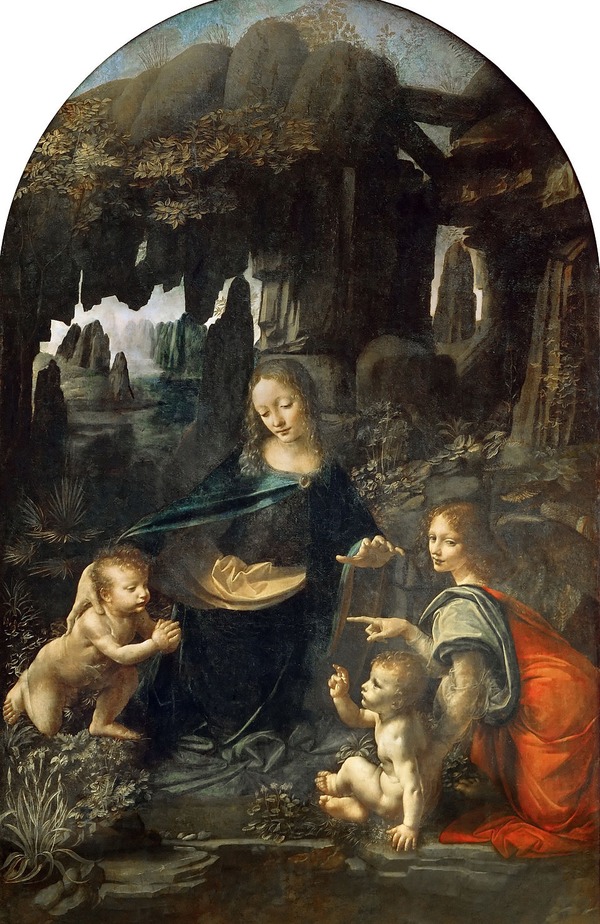
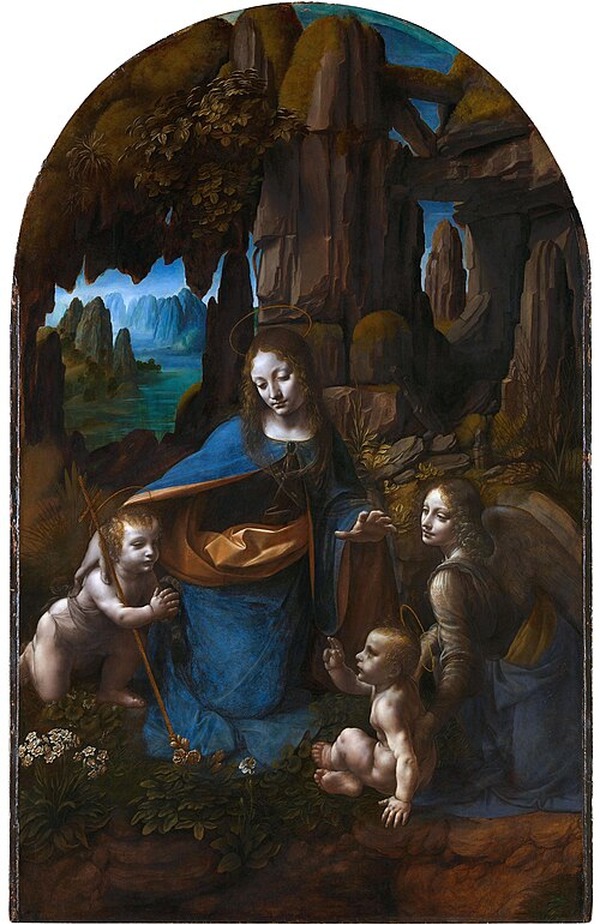
That second, official painting now hangs in the National Gallery, London. The first – the one Leonardo kept, sold, and which eventually found its way into the French royal collection by 1625 – now hangs in the Louvre.
Two paintings. One commission. Twenty-five years. And almost no explanation for any of it.
Which One
Came First?
This question, which might sound administrative, is in fact one of the most fiercely contested problems in all of Western art history. Scholars have changed their minds on it repeatedly. The evidence is genuinely ambiguous.
The majority position – supported by Pietro Marani, Martin Kemp, and the National Gallery – holds that the Louvre version is the earlier work, painted between approximately 1483 and 1486, and that the London version was produced later to fulfill the original contract. The Louvre painting is accepted by almost all authorities as entirely Leonardo's hand. The London version is generally agreed to have been designed by Leonardo and executed with significant workshop assistance.
"For a composition in which the works are identical in terms of iconography, stylistically these paintings are worlds apart."
Katy Blatt – Leonardo da Vinci and the Virgin of the Rocks (Cambridge Scholars, 2017)The minority view – advanced by art historian Taylor among others – argues the reverse: that the London painting is stylistically earlier, more meticulous in its finish and detail, consistent with Leonardo's Florentine training under Verrocchio. In this reading, the Louvre version was painted in the 1490s, for a different and more sophisticated clientele entirely, and its comparisons to the Last Supper and the Virgin and Child with St Anne actually place it later.
Geologist Ann Pizzorusso offered a striking contribution from an entirely different field. She studied the rock formations in both paintings with the rigour of a field survey. In the Louvre version, the grotto is rendered with what she describes as astounding geological accuracy: weathered sandstone in the upper formations, a diabase sill correctly positioned above the Virgin's head with precisely painted columnar joints formed by the cooling of molten rock. The seam between geological formations is exact. In the London version, she concluded, the rocks are synthetic – stylised, without any geological logic. She argues that Leonardo, a consummate observer of nature who could not have violated his own knowledge deliberately, did not paint the rocks in the National Gallery work at all.
The addition of halos to the second version is itself telling. Their absence in the first was radical – Leonardo's Florentine Madonnas almost never included them – and their reappearance in the second has been widely read as a doctrinal requirement, a correction demanded by the Confraternity to bring the painting into orthodox alignment. Something about the first version had made them uncomfortable.
The Angel
Who Points
In the Louvre version, the angel – identified variously as Gabriel or Uriel, and never conclusively as either – turns to look directly out of the frame at the viewer, while extending the right index finger to point at the infant John the Baptist. The gesture is vivid, deliberate, almost theatrical. Studies survive in the Royal Windsor Collection showing that Leonardo planned this pointing hand with considerable care.
In the London version, the pointing hand is gone. The angel's arm rests on his knee. The eyes are cast downward in contemplation. The gaze that once met yours has been removed.
Why?
The conventional reading is that the angel is performing the deesis – indicating John's subordinate but essential role in Christ's mission, the forerunner pointing toward what follows. The gesture toward John signals his status as Precursor, the one who will baptise and announce. Theologically this is tidy. But it does not explain why the Confraternity, after twenty-five years of dispute, required the gesture's removal in the replacement painting.
"The archangel staring at the viewer while pointing – with a most eloquent gesture – towards the kneeling figure of St John. These two characters were not even mentioned in the initial contract."
Academic analysis, MDPI Religions journal, 2021One scholarly reading – advanced by art historian Nico Franz – proposes that the angel's gesture and gaze in the Louvre version deliberately evoke the figure of Salome from the apocryphal Protoevangelium of James: the doubting midwife who tested the Virgin's miraculous conception with her own hand, then repented when an angel appeared to her. In this reading, the angel's pointing finger leads not to John but toward Mary's body – a reference to the doctrine of the Immaculate Conception itself, the very subject the painting was commissioned to celebrate. The Church commissioned a painting about the Immaculate Conception; Leonardo gave them an angel who, on one reading, is testing it.
Whether or not this was Leonardo's intent, the removal of that gesture in the second version is the most legible edit in the entire enterprise. Something about that pointed finger troubled the commission enough to demand its erasure.
Which Child
is Which?
The identification problem is worse than it first appears. In conventional Renaissance iconography, Christ and John the Baptist are distinguished by attributes: John by his camel-hair garment or reed cross, Christ by his divine halo and often by his raised blessing hand. Leonardo stripped almost all of these away in the Louvre version.
The child closest to Mary – under her protective arm – is, by composition and tradition, the one she would protect most: her own son. And yet the angel's hand rests on the back of the other child, presenting him, supporting him. The first child kneels in prayer toward the second; the second raises his hand in benediction toward the first. The angel points at the first. The Madonna's left hand hovers above the second.
The scholarly consensus places Christ on our right – slightly more central, with his blessing gesture, and supported by the angel – and John on our left, closer to Mary's protective arm. But Leonardo has surrounded them with gestures whose ambiguity is hard to read as accidental. He was a painter of extreme deliberation. The compositional studies for this work, preserved in Windsor and Turin, show him working through the positioning obsessively. These ambiguities were not oversights.
Mary's right arm curves protectively around the child on the left (John).
Mary's left hand hovers – not touching – above the child on the right (Christ), in a gesture that has been read as blessing, as protection, and as a gesture invoking the doctrine of divine pre-existence.
The angel's right hand points at John; the angel's left hand supports Christ's back.
Christ's right hand is raised in a gesture of benediction toward John – a gesture typically reserved for Christ when blessing others.
John kneels in prayer, hands together, facing Christ – the posture of supplicant to divine.
Every gesture both identifies and destabilises. Nothing is redundant. Nothing is fully resolved.
The iconographic instability was not unique to Leonardo. The Immaculate Conception was such a new and contested doctrine in 1483 that there was no settled visual language for it. Pope Sixtus IV had only adopted its feast for the Western Church in 1476 – seven years before this commission. Leonardo was being asked to paint something that had never been painted in this form before. He had, as the National Gallery notes, genuine creative latitude. Whether he used that latitude to celebrate the doctrine, to question it, or to do both simultaneously is a question that five centuries of scholarship has not settled.
The Immaculate
Problem
The Confraternity of the Immaculate Conception was a Franciscan institution, and the Immaculate Conception was a Franciscan cause. The doctrine – that Mary was conceived without original sin, before the creation of the world, outside the ordinary mechanisms of human generation – was championed by the Franciscans and contested by the Dominicans. In the 1480s it was not yet dogma; it would not become official Catholic teaching until 1854. Leonardo was painting in the middle of a live theological controversy.
The grotto setting, so strange to modern eyes, has been interpreted by the National Gallery as a direct visual argument for the doctrine. The biblical verses used by supporters of the Immaculate Conception spoke of divine Wisdom being present "from the beginning and before the world." The cave – primordial, dark, before architecture, before human time – places the scene at the earliest moments of creation. The water in the background, shallow and green, suggests the waters of Genesis before the earth was divided from the sea. The cone-shaped rocks appear to erupt from the earth itself, as though newly formed.
Mary, in this reading, is not just a mother but Wisdom itself: pre-existent, outside of history, encountered in the first moments of creation rather than in a stable in Bethlehem. The cave is not a hiding place. It is a theological space.
"In some measure [Mary] is that female personification of Nature – 'the mistress of all masters' – to whom Leonardo was more particularly devoted."
Charles Nicholl – Leonardo da Vinci: The Flights of the MindAnd yet the painting's relationship to the doctrine it was commissioned to celebrate remains structurally ambiguous. The Confraternity expected prophets. They expected orthodox attributes. They expected, presumably, the clear visual subordination of John to Christ that their theology required. They got a painting in which Mary shelters John under her arm as warmly as she shelters no one, and an angel who points at John while looking out at you. The dispute over completion and payment that followed the delivery may have been financial. It may also have been doctrinal. The surviving documents, characteristically, tell us almost nothing about which.
The Cave That
Leonardo Remembered
In his notebooks, Leonardo recorded what may have been one of the formative experiences of his life. As a young man, wandering through the Apennines, he came to the entrance of a great cavern. He hesitated at the mouth of it – "fearing," he wrote, "some dangerous wild beast" – and then entered, "drawn by a desire to see whether there might be any marvelous thing within."
He found, embedded in the cave walls, what appears to have been the fossilised bones of a whale: an enormous creature from a vanished sea, preserved in rock, testifying to a time when this was ocean floor. He wrote about it with something close to philosophical vertigo – addressing the fossil directly, meditating on the relationship between deep time and divine creation, between the world as scripture described it and the world as the rocks themselves recorded it.
Leonardo's understanding of geology was centuries ahead of his contemporaries. In the Codex Leicester, he wrote about fossils as evidence of former worlds. He understood sedimentary strata as records of time – not the single biblical flood, but successive accumulations across spans of history that the Church's chronology could not accommodate. He wrote, in effect, that the earth was far older than anyone in his era officially accepted. He held this knowledge quietly, privately, in notebooks that went largely unread during his lifetime.
In the Louvre version, geologist Ann Pizzorusso identified: rounded weathered sandstone at the top of the grotto; a diabase sill injected as molten rock above the Virgin's head; correctly rendered columnar joints formed by the rock's contraction as it cooled; and a precisely painted basal contact – the horizontal seam between geological formations. Each element is geologically consistent with the others. This is not decorative rock painting. It is a scientifically accurate cross-section of a real geological formation, rendered by a man who understood what he was looking at.
The grotto in the Virgin of the Rocks is not imaginary. It is assembled from Leonardo's direct observation of caves in the Tuscan and Lombard countryside. The geologically accurate formations in the Louvre version are consistent with real formations in the Italian Apennines, combined – as art historians have noted – with atmospheric backgrounds that recall the Alpine lakes north of Milan. When Leonardo placed the Virgin in a cave, he was placing her in geological time. In the oldest space he could imagine. In the earth's own memory.
Whether this was iconographically sanctioned or a private act of intellectual audacity – painting the Mother of God in the stone record of a world older than scripture – is, like almost everything else about this painting, unresolved.
What the Plants
Are Saying
Leonardo painted the botanical foreground of the Louvre version with a precision that was immediately legible to any educated viewer in 1483. Every plant was identifiable. Every plant meant something.
Around the figures grow: primrose, positioned at Christ's knee – a known emblem of the Saviour's sinlessness. Cyclamen near his feet, associated with the Virgin. A palm behind John, which carries multiple meanings: Marian symbolism, the martyrdom that awaits John, and – in one reading – a visual pun on the scallop shell associated with the doctrine of the Immaculate Conception. A columbine near Mary's head, associated with the seven sorrows of the Virgin. Aquilegia, associated with the Holy Spirit.
At the precise compositional centre of the painting, Mary's cloak is fastened by a brooch. At its centre is a stone. Surrounding it is a ring of twenty pearls. Follow the trajectory of Mary's cloak hem from those pearls to the open palm of the tree nearby: pearls and scallop shell, in direct visual correspondence. Pearls were then believed to form supernaturally from a drop of purest dew – untouched, unmixed. A visual argument for immaculate conception encoded in jewellery.
In the London version, the botanical precision is gone. The National Gallery notes that the flowers there "don't resemble any real flowers – they're hybrids of different plants." Britannica offers an observation of remarkable implication: that by the time Leonardo painted the second version, "he no longer considered the role of the painter as a chronicler of the world, but as a creator of new worlds, much like a god." The botanical inventory was an argument. Leonardo had moved past the need to make it.
The Painting
Beneath
In 2019, the National Gallery announced the results of macro X-ray fluorescence mapping on the London version: materials containing zinc had been used for the underdrawing, making it newly visible to scientific imaging. What the analysis revealed was not one earlier composition beneath the paint surface, but two.
In the first hidden composition, the angel holds the infant Christ significantly higher and more tightly. Both figures sit in an elevated position. The Virgin looks toward them rather than downward. This initial design was substantially different from what Leonardo ultimately painted – the figures in different positions, the emotional relationships between them structured differently.
A second underdrawing is closer to the final version, but still departs from it: Christ's head appears in profile rather than three-quarter view; some of the angel's characteristic curls are absent. Handprints are visible in the priming of the panel – from either Leonardo or an assistant patting down the ground layer before painting began.
What this means, practically, is that the painting on the wall of the National Gallery contains at least two complete abandoned compositions beneath its surface. Leonardo changed his mind at least twice before arriving at the arrangement we now see. The painting, in the most literal sense, is a palimpsest: a surface written over, revised, reconsidered. The image we know was arrived at through doubt.
The Louvre version was examined by X-ray earlier, and revealed its own hidden compositions: an earlier state in which the Virgin appears to be in a different posture, one hand possibly holding a child and the other outstretched. Some researchers believe Leonardo's original intention for the first version was an Adoration of the infant Jesus – a conventional subject – before he redirected the composition toward the enigmatic scene we now know.
"The newly discovered drawings were made using materials that contained zinc, enabling them to be seen in macro X-ray fluorescence maps. In the first composition, the angel holds the infant Christ much more tightly, and both figures are positioned higher."
Artsy, reporting on National Gallery research, 2019The Angel's
Face
Three preparatory drawings survive for the angel in the Louvre version: a study for the head, a study of the drapery while kneeling, and a copy of a study for the pointing hand. These are held in the Royal Windsor Collection and the Biblioteca Reale in Turin. They record a care for the angel's face and pose that goes beyond the requirements of compositional planning.
The angel in the Louvre version – the one who meets your eyes while pointing at John – has long attracted attention for a quality of intimacy that is difficult to categorise. The smile is not the Virgin's smile. It is knowing in a different register: personal, directed, almost conspiratorial. Some art historians, noting Leonardo's close relationship with his apprentice Gian Giacomo Caprotti – nicknamed Salai, "little devil," taken into Leonardo's household at the age of ten and remaining with him for twenty-five years – have suggested that Salai was the model for this figure.
If that reading holds, the angel who gazes directly at the viewer from within this contested, doctrinally freighted, legally disputed masterpiece is the face of Leonardo's most intimate companion – looking out at us from inside a painting about divine grace, bearing an expression that is neither wholly reverent nor wholly secular, pointing at something whose meaning the painter never explained.
The London version removes this gaze. The angel looks down. Whatever that look contained, it was edited out.
What Remains
Unresolved
After five centuries of scholarship, scientific imaging, archival recovery, geological analysis, botanical identification, and iconographic debate, the Virgin of the Rocks retains its core mysteries with complete composure.
We do not know why Leonardo deviated so substantially from his brief. We do not know whether the deviation was a private theological position, a deliberate provocation, a negotiated revision, or simply the consequence of an artist who knew that what he wanted to paint was more interesting than what he had been asked for. We do not know who the pointing angel is looking at or why the gesture was removed. We cannot be certain which child is which without the attributes Leonardo withheld. We cannot confirm whether the geological precision of the grotto was a devotional act, a scientific one, or both.
We do not know who, in the end, the Louvre painting was painted for. Marani's best guess is Ludovico Sforza. The first certain record of it places it in the French royal collection in 1625. The intervening decades are silence.
What we have are two paintings of the same subject, created by the same hand across twenty-five years, the first of which may encode a private argument about geology and time, the second of which may record the corrections required to make the first one doctrinally acceptable. Between them is a pointing finger that was deemed important enough to plan carefully and important enough, later, to remove entirely.
Leonardo left no account of any of this. His notebooks contain landscapes, anatomy, engineering drawings, water studies, and investigations into the properties of light. They do not contain an explanation of the Virgin of the Rocks. Whatever he was thinking, he thought it in paint.