Picasso
La Vie
Picasso painted over his own face. X-rays reveal a self-portrait beneath the anonymous man. He replaced himself with the dead friend whose suicide haunted him.
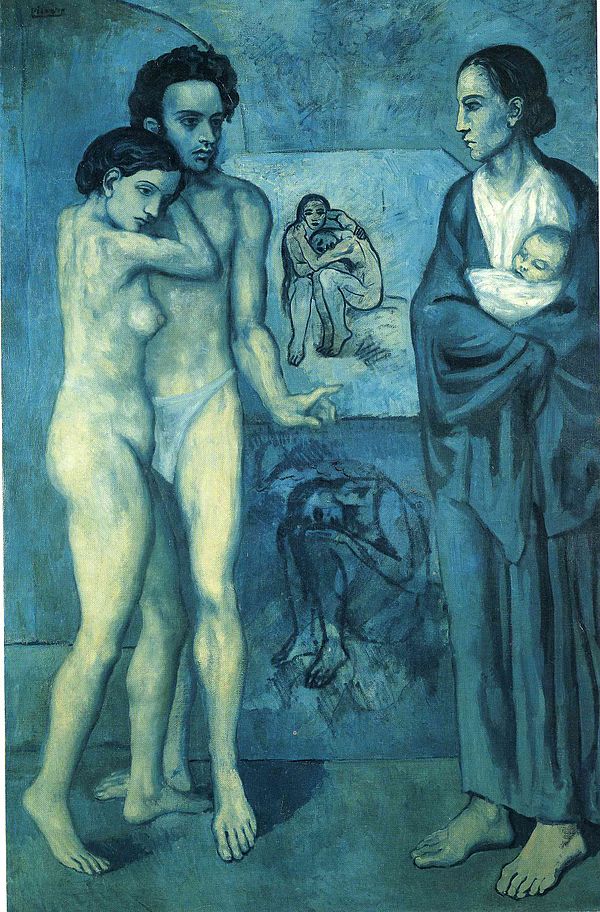
Pablo Picasso, La Vie, 1903. Cleveland Museum of Art.
A naked man and a naked woman stand on the left side of the canvas. The man's left arm wraps around the woman's shoulder. His right arm extends outward, gesturing toward a figure on the opposite side of the painting - a cloaked woman holding a swaddled infant against her chest. She stares back at the couple. Between the two groups, slightly recessed as though leaning against a studio wall, two paintings appear within the painting: a crouching nude figure huddled in on itself, and two intertwined bodies pressed together in something between embrace and collapse.
The figures are thin. Not idealized, not athletic - thin in the way people are thin when they do not eat enough. The man's ribs are visible. The woman's body presses against his without warmth. They lean on each other the way exhausted people lean, not out of passion but out of need. The cloaked woman on the right, by contrast, stands upright and solid. The infant in her arms gives her a center of gravity the couple on the left does not have. She is rooted. They are drifting. The space between the two groups - a gap of perhaps two feet in the painting's internal logic - reads as unbridgeable.
The entire canvas is blue. Not accented with blue, not tinged or washed. Blue saturates every surface - the skin of the figures, the floor, the background, the fabric of the cloak, the smaller canvases. It is a monochrome environment in which hue has been replaced by value. Light and dark are the only variables. Color, in any conventional sense, has been suppressed. The blue is not decorative. It is atmospheric, like fog or depression or the hour before dawn when nothing has edges.
The composition reads left to right as a sequence: youth and sexuality on the left, art in the center, maternity and age on the right. The naked couple is young, thin, exposed. The cloaked woman is older, covered, holding new life. The two paintings-within-the-painting sit between them like arguments or memories or things that cannot be spoken aloud. Whether the man is gesturing toward the mother in accusation, supplication, or explanation is not clear. The gesture is open. It could mean anything.
The painting is large - 196.5 by 129.2 centimeters, roughly six and a half feet tall by four and a quarter feet wide. It was painted in Barcelona in the spring of 1903, in a studio Picasso shared on the Carrer del Comerç. He was twenty-one years old. It is the largest, most complex, and most deliberately composed painting of his Blue Period, and it is the one into which he painted - and then erased - his own face.
X-ray radiography conducted by the Cleveland Museum of Art's conservation department reveals a face beneath the face of the man on the left. The face is Picasso's. It is unmistakable in the X-ray plates - the dark eyes set close together, the strong jaw, the particular way the hair falls across the forehead. Picasso originally painted himself into the composition. He stood where the naked man stands, his arm around the woman, his gesture directed at the cloaked mother. He was the figure at the center of the allegory.
Then he painted over it. He replaced his own features with those of Carlos Casagemas - his closest friend, dead by his own hand two years earlier. The replacement was not a correction of anatomy or a refinement of technique. It was a substitution of identity. Picasso removed himself from the painting and put the dead man in his place. Infrared reflectography confirms the sequence: the self-portrait came first, the Casagemas portrait was layered on top. The brushwork of the upper layer is confident, deliberate. This was not a tentative revision. Picasso knew what he was doing.
The pentimento transforms the painting's meaning completely. If the man is Picasso, La Vie is a self-examination - a young artist positioning himself between sexuality and responsibility, between art and life. If the man is Casagemas, La Vie is an elegy. The dead friend stands where the living painter stood. He gestures toward a future he will never enter. The mother holds a child he will never have. The paintings on the wall behind him depict the suffering he could not survive. The substitution turns autobiography into memorial.
This is one of the most extensively documented pentimenti in modern art. The Cleveland Museum has published the X-ray plates, the infrared scans, the conservation reports. There is no ambiguity about what lies beneath the surface. Picasso's face is there. He painted it, looked at it, and decided that the dead man should stand in his place. The painting is a portrait of Casagemas made on top of a portrait of Picasso, and the fact that both exist in the same space - one visible, one hidden - is not incidental to the work. It is the work.
X-ray radiography: Picasso's self-portrait clearly visible beneath the male figure's face. Features match contemporary self-portraits from 1901-1903.
Infrared reflectography: Confirms the self-portrait was painted first and the Casagemas likeness applied over it in a deliberate second campaign.
Underlying canvas: A third composition - "Last Moments" (1899) - exists beneath both versions of La Vie. Picasso reused the canvas from his Paris Exposition Universelle entry.
Preparatory studies: Multiple sketches survive showing the composition's evolution, including versions where the male figure is clearly Picasso himself.
Paint layer analysis: The blue pigment is predominantly Prussian blue, applied in thin glazes over a warm ground. The skin tones use lead white mixed with blue rather than traditional flesh-tone palettes.
Canvas dimensions: 196.5 x 129.2 cm. The large format matches the dimensions of "Last Moments," confirming the reuse. Tacking edges show the canvas was restretched at least once between compositions.
"He painted himself into the picture, then painted himself out. The dead man took his place. The pentimento is a confession of survivor's guilt encoded in oil paint."
Carlos Casagemas traveled to Paris with Picasso in October 1900. They were both nineteen. The trip was supposed to be the beginning of everything - two young painters from Barcelona arriving in the capital of the art world, sharing a studio in Montmartre, selling work, making contacts, building careers. Picasso adapted quickly. Casagemas did not. He fell in love with a model named Germaine Pichot, who worked in the studios and cafes of the neighborhood. She did not return his feelings. The rejection consumed him.
On the evening of February 17, 1901, Casagemas arranged a dinner at a small cafe on the Boulevard de Clichy. Several friends attended, including Germaine. At some point during the meal, Casagemas stood, produced a pistol, and fired at Germaine. The bullet either missed or grazed her neck - accounts vary. He then turned the gun on himself and shot himself in the right temple. He died that night. He was twenty years old. Picasso was in Madrid when it happened. He learned of the suicide by letter or telegram. He did not attend the funeral.
The death broke something open. Picasso had known grief before - he had lost his younger sister Conchita to diphtheria when he was thirteen - but Casagemas's suicide was different. It was violent, public, caused by romantic despair, and it happened to the person who had been closest to him during the most formative months of his young life. They had shared a studio. They had shared meals, conversations, ambitions. Casagemas was not a peripheral figure. He was the companion of Picasso's first encounter with Paris, and he destroyed himself over a woman who did not want him.
There is a further detail that biographers have noted with discomfort. Picasso, within a year of Casagemas's death, began a relationship with Germaine Pichot - the same woman Casagemas had died for. Whether this was callousness, compulsion, or some complicated act of possession and identification with the dead man is impossible to determine from the outside. But it is part of the context in which La Vie was made. Picasso was sleeping with the woman his dead friend had killed himself over, and then he painted that dead friend into an allegory about love and loss and motherhood. The painting does not depict this triangle. But the triangle is behind it, pressing on every surface.
The suicide is the origin point of the Blue Period. Art historians have debated whether the monochrome palette was influenced by other factors - Picasso's own poverty, his exposure to El Greco during his time in Spain, the general mood of fin-de-siecle melancholy - but the chronology is difficult to argue with. Before February 1901, Picasso painted in bright, varied colors. After February 1901, he began painting in blue. The transition was not instantaneous, but it was directional. The death of Casagemas pushed the color out of Picasso's work and left behind a palette of mourning.
- There is a painting beneath the painting beneath the painting. La Vie was not made on a fresh canvas. Picasso painted it over "Last Moments," a large work he exhibited at the 1900 Paris Exposition Universelle. No photograph of the finished painting survives, though a preparatory sketch does. He reused the canvas - turned it, scraped parts of it, and painted La Vie directly on top. So there are three layers: "Last Moments" (1899) at the bottom, Picasso's self-portrait version of La Vie in the middle, and the final version with Casagemas's face on top.
- The canvas is a palimpsest of grief. Each layer is a different painting about a different kind of loss. "Last Moments" was a deathbed scene, possibly inspired by his sister Conchita's death from diphtheria. The self-portrait version was about a living artist confronting life's demands. The final version is a memorial to a dead friend. Three paintings. Three deaths. One surface.
- The cloaked woman may have migrated from the painting underneath. Some scholars have suggested that her pose and position echo a figure from the underlying "Last Moments" deathbed scene, as though she survived each revision and climbed upward through the layers. The X-rays show structural alignments between the lower composition and the upper one that support this reading.
- The two paintings-within-the-painting are real works. The crouching nude and the intertwined figures are not invented for the composition. They reference studies Picasso was making at the time - works on isolation and entanglement that recur throughout his Blue Period sketchbooks. They function inside La Vie as the interior argument: the crouching figure is solitude, the intertwined figures are dependence.
- Preparatory sketches show the evolution. Multiple drawings survive in which the male figure is unmistakably Picasso. In one, the composition includes a bearded artist at an easel - a third figure later eliminated. The decision to remove the artist figure and then to replace his own face with Casagemas's happened in stages, each one pulling the painting further from autobiography and closer to elegy.
- Germaine Pichot survived and married Picasso's friend. The woman Casagemas tried to kill went on to marry the painter Ramon Pichot, who was part of the same Barcelona circle. Picasso continued to see her socially for years. She appears in later works. The web of relationships around this painting did not end with the gunshot.
- The setting is a studio, not a domestic space. The paintings leaning against the wall, the bare floor, the absence of furniture - this is an artist's workspace. The allegory unfolds inside the place where art is made, as though the confrontation between love and duty can only happen in the room where the painter works. The studio is not a neutral backdrop. It is the third space in the painting, after the couple's space and the mother's space, and it belongs to neither of them.
Carlos Casagemas i Coll was born in 1880 in Barcelona, the son of the American consul general to Spain. His family was wealthy, Catalan, cultured. He studied painting. He was handsome, sensitive, prone to melancholy. He and Picasso met as teenagers in the circle of young artists who gathered at the tavern Els Quatre Gats on the Carrer de Montsio, a cafe modeled on Le Chat Noir in Paris and frequented by the Catalan avant-garde. Casagemas was not the most talented painter in the group. Picasso was. But they were close - close enough to share a studio, close enough to travel together, close enough that Casagemas's death would reshape Picasso's work for four years.
Picasso drew Casagemas repeatedly during their time together. Quick sketches, caricatures, portraits in pen and ink. In one, Casagemas sits slumped in a chair, hat pulled low, looking like a man who has already given up on something. In another, he stands with theatrical stiffness, a dandy putting on a performance. These drawings are the record of a friendship conducted in close quarters - two young men who saw each other daily, who knew each other's postures and habits and the way each one held a cigarette. When Picasso later painted the dead man's face onto the body in La Vie, he was not working from a photograph. He was working from years of accumulated looking.
In Paris, Casagemas unraveled. His obsession with Germaine Pichot - whose real name was Laure Gargallo - became consuming and irrational. She was involved with other men. She was not interested in exclusivity. Casagemas, by several accounts, was impotent or believed himself to be, which compounded his despair. He drank heavily. He became erratic. Picasso left Paris for Madrid in late January 1901, partly to pursue his own career and partly, some biographers suggest, because he could no longer manage Casagemas's deterioration. Three weeks later, Casagemas was dead.
After the suicide, Picasso painted Casagemas's corpse. Not once but repeatedly. "The Death of Casagemas" (1901) shows the body with the bullet wound visible at the temple, painted in blues and greens, the face lit by candlelight or gaslight. "Casagemas in his Coffin" (1901) is a smaller, more intimate study - the face in repose, the wound dark against pale skin. "Evocation (The Burial of Casagemas)" (1901) is the most ambitious of the three: a large, multi-figure composition in which Casagemas's body rises toward a sky populated by women on horseback, a surreal apotheosis that mixes grief with irony and Catholic iconography with brothel imagery. The painting's upper register is paradise. Its lower register is mourning. The dead man ascends between them.
La Vie came two years after these paintings. It is not another portrait of the corpse. It is something harder - a portrait of the living man, placed in an allegory he did not choose, given a gesture he never made, standing in a space that was originally occupied by the painter who survived him. If the three 1901 paintings were acts of immediate mourning, La Vie is the work of sustained processing. Picasso painted his friend alive, gave him a body and a woman and an outstretched hand, and then surrounded him with the imagery of suffering. It is the culmination of everything Casagemas's death produced in Picasso's work - the final attempt to make the loss mean something, or to admit that it could not.
The Blue Period runs from late 1901 to early 1904. It is defined by a monochrome palette - blues, blue-greens, occasional flashes of white - and by a subject matter drawn from the margins of society: beggars, blind men, emaciated mothers, solitary drinkers, prisoners, prostitutes, the old, the hungry, the alone. Picasso was twenty when it began and twenty-three when it ended. He was broke for most of it. He lived in unheated studios in Barcelona and Paris, burned his own drawings for warmth, ate irregularly, depended on the generosity of friends. The paintings of this period are not observations of poverty made from a comfortable distance. They are produced from inside it.
The Blue Period was commercially disastrous. Dealers did not want monochrome paintings of starving people. Collectors did not want to hang misery on their walls. Picasso's friend and early dealer Pere Manach had secured him a stipend of 150 francs a month during his first year in Paris, but the arrangement ended. Ambroise Vollard, who would later become one of the most important dealers of the twentieth century, bought a handful of Blue Period works but showed little enthusiasm. The paintings piled up in studios. They went unsold, unstretched, stacked against walls. La Vie, the most ambitious of them all, left Picasso's hands relatively quickly - it was acquired by the Parisian dealer Jean Saint-Gaudens - but for a price that did not reflect its scale or its cost in materials and labor.
La Vie is the masterwork. It is the largest Blue Period canvas, the most compositionally complex, the most iconographically dense. It synthesizes the themes Picasso had been working through for two years - sexuality, death, maternity, isolation, the relationship between the artist and the world - into a single allegorical scene. Every other Blue Period painting addresses one of these themes. La Vie tries to hold all of them at once. The ambition is visible in the scale, in the number of figures, in the paintings-within-the-painting, in the gesture of the man's hand that tries to connect the left side of the composition to the right, youth to age, desire to duty.
The blue itself was not an aesthetic decision. Or rather, it was not primarily an aesthetic decision. Blue is the color of distance, of things seen through atmosphere, of objects receding from the eye. It is the color the world turns when warmth is removed. Picasso did not choose blue because it was beautiful. He chose it because it was the color of the emotional state he could not leave - a state triggered by Casagemas's death, sustained by poverty and isolation, and resolved only when new relationships and new circumstances pulled him out of it and into the warmer palette of the Rose Period.
Today the Blue Period paintings are among the most valuable works of art in existence. "The Old Guitarist" is one of the signature holdings of the Art Institute of Chicago. "La Vie" is the crown of Cleveland. "Boy Leading a Horse" was in the collection of William S. Paley. "La Celestina" sold at auction for figures that would have paid Picasso's rent for several lifetimes. The paintings that could not be sold in 1903 are now worth more than almost anything else on the secondary market. The irony is structural: the paintings were produced by poverty, about poverty, and are now accessible only to extraordinary wealth.
La Vie is also the last major Blue Period painting. After completing it in the spring of 1903, Picasso continued to work in blue, but the monumental ambition subsided. The paintings that followed - "The Old Guitarist," "The Tragedy," "La Celestina" - are smaller, more focused, less allegorical. By 1904, when Picasso moved permanently to Paris and settled in the Bateau-Lavoir studio in Montmartre, the blue was fading. He met Fernande Olivier. He entered a new social world. The Rose Period began. La Vie stands at the end of the blue corridor like a locked door. Everything Picasso needed to say in that register, he said in this painting.
"La Vie" means "Life" in French. The title has been read as straightforward - this is a painting about life, about the stages of human existence, about the passage from youth to age - and as ironic, given that the central figure is a dead man painted over a living one. Both readings are sustainable. The painting supports them simultaneously without resolving the contradiction. It is called "Life," and it is saturated with death. It depicts a man who is alive in the painting and dead in the world. It was made by a survivor standing in for the person who did not survive.
The allegorical readings have multiplied over a century of scholarship. The painting has been interpreted as a confrontation between sexual love and maternal love, with the man's gesture serving as either an offering or an accusation. It has been read as a meditation on the relationship between art and life, with the two paintings-within-the-painting representing the artist's interior world pressed against the exterior demands of responsibility and reproduction. It has been analyzed through Freudian, Marxist, and biographical lenses. None of these readings has been definitively accepted. None has been definitively rejected.
The ambiguity is compounded - made structural, made permanent - by the pentimento. If the man is Picasso, the painting is about a living artist choosing between desire and duty. If the man is Casagemas, the painting is about a dead man frozen in a choice he never got to make. The meaning of every element shifts depending on which face you consider: the face you can see, or the face beneath it. The gesture changes. The mother changes. The paintings-within-the-painting change. Even the title changes. "Life," addressed to a self-portrait, is aspiration. "Life," addressed to a dead man, is elegy.
Picasso never explained the painting. He was asked about it in interviews across the decades - he lived until 1973, more than seventy years after painting it - and he declined to interpret it. He did not deny the pentimento. He did not confirm it. He let the painting exist in its layered, unresolved state, a work that contains its own revision and refuses to say which version is the real one.
The painting arrived at the Cleveland Museum of Art in 1945, purchased from a private collection for what was then a significant sum. It has remained there since, a centerpiece of the European galleries, the single most important Blue Period work in any American museum. Visitors stand before it and see a blue painting of nude figures and a mother and child. Most do not know about the face underneath. Most do not know about "Last Moments" underneath that. The painting keeps its secrets in plain sight - layered, literal, sealed beneath the surface. The title may be the only honest thing about it. It is called "Life." Life is what it is about. Everything else - the dead friend, the hidden face, the blue - is detail.
Cleveland Museum of Art. Conservation records, X-ray radiography, and infrared reflectography documentation for La Vie (1903.396). Collection notes and provenance history.
Richardson, John. A Life of Picasso, Volume I: The Early Years, 1881-1906. Random House, 1991. Chapters 15-18 on the Blue Period, the Casagemas suicide, and the Barcelona studio years.
McCully, Marilyn. Picasso in Paris 1900-1907. Thames & Hudson, 2011. Documentation of the Montmartre studio period, early Paris relationships, and the circumstances of Casagemas's death.
Galassi, Susan Grace. Picasso's Variations on the Masters: Confrontations with the Past. Harry N. Abrams, 1996. Analysis of reused canvases, palimpsest compositions, and the "Last Moments" substrate.
Daix, Pierre, and Georges Boudaille. Picasso: The Blue and Rose Periods. New York Graphic Society, 1967. Catalogue raisonne entries for the Blue Period, including preparatory studies for La Vie.
Cowling, Elizabeth. Picasso: Style and Meaning. Phaidon, 2002. Iconographic analysis of the allegory and the paintings-within-the-painting motif.