Van Gogh
Patch of Grass
Poverty, not intention. He was reusing canvases he could not afford to replace. X-rays found a portrait of a peasant woman buried beneath the Paris landscape.
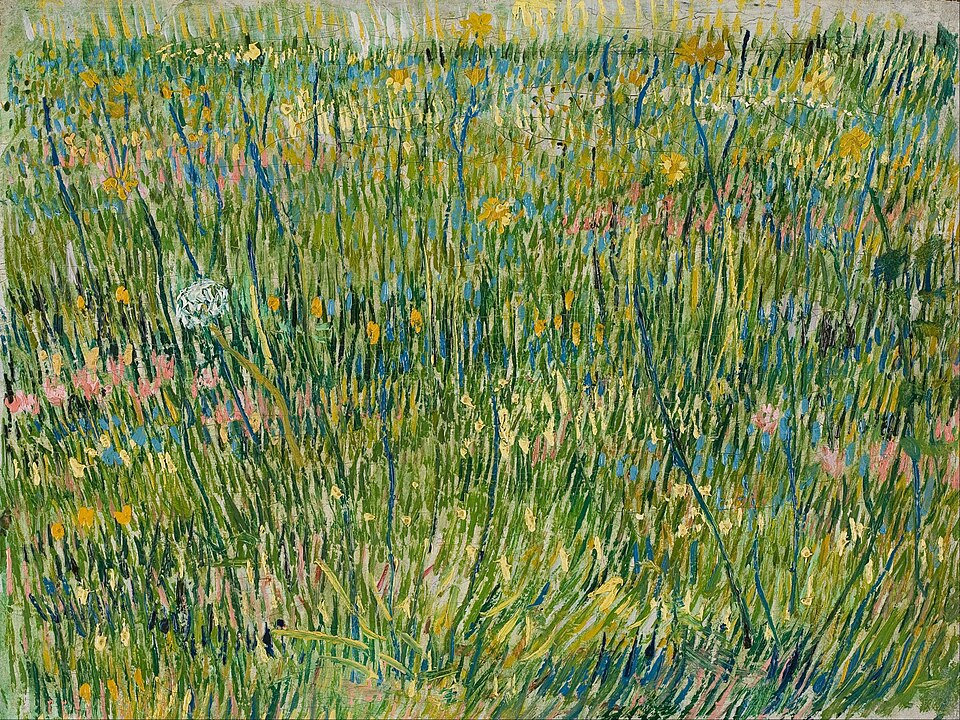
Vincent van Gogh, Patch of Grass, 1887. Public domain.
A small patch of wild grass and weeds, painted with thick impasto strokes in greens, yellows, and touches of blue. There is no horizon. There is no sky. There is no path, no building, no figure, no context of any kind. The viewer looks down - or across at very close range - at a tangle of vegetation that fills the entire canvas edge to edge. It is not a landscape. It is a fragment of ground, extracted from its surroundings and presented without explanation.
The brushwork is vigorous, almost violent. Van Gogh has applied the paint in short, directional strokes that follow the growth pattern of the grass - upward, outward, bending under their own weight. Individual blades are rendered not as lines but as thick ridges of pigment, built up in layers that catch physical light and cast real shadows across the surface. The texture is aggressive. You could close your eyes and read this painting with your fingertips.
It is a Paris painting, made during Van Gogh's two years in the city between March 1886 and February 1888. The palette confirms this. The greens are bright and varied - chrome green, viridian, emerald - mixed with yellows and punctuated by flecks of complementary color. This is not the dark, earthy palette of his Dutch period. This is the palette of a painter who has seen Impressionism and begun to absorb it. The color is deliberate, almost theoretical. He was learning to use complementary contrasts, and the grass gave him a laboratory.
The dimensions are modest: approximately 31 by 40 centimeters. A modest, overlooked work in his catalog. It hangs in the Kroller-Muller Museum in Otterlo, in the Netherlands, surrounded by larger and more celebrated canvases. Most visitors walk past it. It does not announce itself. It is a painting that requires you to stop and look closely, and most people do not.
In 2008, researchers at Delft University of Technology used synchrotron radiation X-ray fluorescence at the DESY facility in Hamburg to scan the painting. The technique fires an intense beam of X-rays at the paint surface, exciting the atoms of individual pigments and causing them to fluoresce at characteristic energies. By mapping these fluorescence signals pixel by pixel, the researchers could reconstruct images of specific chemical elements at specific depths within the paint layers - seeing through the visible surface to whatever lay beneath it.
What they found was a complete portrait of a peasant woman. A face. A bonnet. The outline of a figure, rendered in pigments that had been entirely covered by the later landscape. The portrait was not a sketch or an abandoned start. It was a finished - or near-finished - painting in its own right, with enough detail and pigment density to produce a full-color reconstruction from the elemental maps. She had been there the entire time, invisible beneath the grass.
The portrait is stylistically consistent with Van Gogh's Nuenen period, from 1883 to 1885, when he lived in a small village in the province of North Brabant and painted dozens of studies of peasant men and women. The dark palette, the heavy features, the bonnet - all of it belongs to the same body of work that produced The Potato Eaters. Van Gogh had painted the woman in Holland. He had carried the canvas to Paris. And then he had painted over her, covering the portrait entirely with the patch of grass that now hangs on the museum wall.
He did not paint over her because the portrait was bad. He did not paint over her as a gesture of revision or artistic rejection. He painted over her because he could not afford a new canvas. The pentimento beneath Patch of Grass is not a record of artistic decision. It is a record of poverty.
Hidden portrait: A complete peasant woman - face, bonnet, figure - painted in Nuenen-period pigments, entirely invisible beneath the Paris landscape.
First color reconstruction: Individual elements mapped (antimony for lead-tin yellow, mercury for vermilion, cobalt for blue) and combined to produce a full-color image of the hidden portrait.
Stylistic match: The portrait is consistent with Van Gogh's 1883-1885 Nuenen head studies - the same series that produced The Potato Eaters.
Reason for overpainting: Not artistic rejection. Poverty. Van Gogh could not afford a new canvas.
"The peasant woman was not erased by choice. She was erased by poverty. Van Gogh could not afford to let her exist."
Van Gogh arrived in Paris in March 1886, uninvited and largely unannounced. He moved in with his brother Theo, who worked as an art dealer at Boussod, Valadon and Cie on Boulevard Montmartre. Theo had been supporting Vincent financially for years - a monthly allowance that covered paint, canvas, rent, and food, though never enough of any of them. The arrangement was constant and constantly strained. Vincent spent everything. Theo sent more. The letters between them are a long negotiation over money, guilt, and the cost of materials.
Canvases were expensive. A prepared canvas of even modest size represented a meaningful fraction of a month's allowance. Van Gogh economized in every way he could. He bought cheap canvas, sometimes linen of the lowest commercial grade. He used cardboard when canvas was unavailable. He painted on both sides of panels. And he painted over earlier works - his own - when the subject no longer interested him or when the need for a fresh surface outweighed the value of what was already there.
The peasant woman beneath Patch of Grass is one of dozens of hidden paintings from this period. When Van Gogh left Nuenen for Antwerp and then Paris, he brought stacks of canvases with him - the peasant studies, the still lifes, the dark cottage interiors of his Dutch years. In Paris, surrounded by the color and light of Impressionism, these dark paintings from the provinces must have seemed like relics of another life. They became raw material. He turned them face down, or face up, and painted something new on top.
Van Gogh did not consider this destruction. There is no record of remorse or even awareness that what he was doing might be viewed as loss. It was simply how a poor painter worked. You used what you had. The hidden image was never meant to be seen again. The woman in the bonnet was not a secret. She was spent material.
The synchrotron scan was groundbreaking not because it revealed a hidden painting - X-rays had been used to find hidden layers since the 1930s - but because it reconstructed the hidden painting in color. Conventional X-radiography produces a grayscale image based on how much radiation the paint absorbs, which is dominated by lead white and tells you almost nothing about hue. The Delft/DESY technique was different. It mapped individual chemical elements - antimony in the lead-tin yellow, mercury in the vermilion, cobalt in the blue - and assigned each element its known pigment color. The result was not a shadow or a silhouette. It was a full-color portrait, emerging element by element from beneath the grass.
The scan also revealed something unexpected about Van Gogh's development. The two paintings on one canvas - the Nuenen portrait below, the Paris landscape above - document a transformation in palette that is more dramatic when seen in direct superposition than when compared across separate works. The portrait is built from earth tones: ochres, raw umber, blacks, the somber range of the Dutch tradition. The landscape is vivid: bright greens, chrome yellows, touches of ultramarine. They are separated by only two or three years. The same hand made both paintings. The stylistic distance between them is enormous.
This is what most people miss when they look at Patch of Grass, if they look at it at all. The painting is not simply a study of vegetation. It is a palimpsest - a surface that has been written on, erased, and written on again, with the original text still legible beneath if you have the right tools. The peasant woman and the Parisian grass coexist in the same object, occupying the same physical space, separated only by a few hundred microns of oil paint. One canvas contains two painters: the dark, provincial Van Gogh of Nuenen and the bright, experimental Van Gogh of Paris. His entire artistic evolution is compressed into a single stretched rectangle of linen.
The Kroller-Muller Museum displays the painting without prominent mention of the hidden portrait. There is no side-by-side reconstruction on the gallery wall, no dramatic reveal. The peasant woman exists primarily in the scientific literature and in reproductions circulated online. In person, she remains invisible. You stand in front of the grass and you see only the grass. She is there - her face, her bonnet, her heavy Dutch features - but she requires technology to reach. The painting keeps its secret from the naked eye.
From late 1883 to late 1885, Van Gogh lived in Nuenen, a small village in the province of North Brabant in the southern Netherlands. His father was the pastor of the local Reformed church. Vincent occupied a room in the family home and later a small studio nearby. He was thirty years old when he arrived, largely self-taught, and consumed by a single ambition: to paint the lives of peasants with the directness and sympathy he had found in the work of Jean-Francois Millet.
He was obsessed with faces. Over the course of two years, he produced more than forty portrait studies of peasant heads - men and women, young and old, seen in dim interiors lit by windows or oil lamps. The paintings are small, dark, and blunt. The features are heavy. The light is meager. The palette is restricted to browns, ochres, olive greens, and blacks, with occasional touches of dull red or muted blue. They are not flattering portraits. They are studies of labor, fatigue, and endurance, painted quickly from life in sessions that sometimes lasted less than an hour.
The woman hidden beneath Patch of Grass belongs to this series. Her bonnet, her features, and the tonal range of the portrait all place her firmly within the Nuenen head studies. She is one of dozens. Van Gogh painted these women in their homes, at their work, in their church clothes. He was building a visual archive of peasant life - a project that culminated in The Potato Eaters (1885), his first major composition, in which five figures sit around a table eating potatoes by lamplight. The painting was a deliberate statement of ambition. The head studies were its preparation.
When Van Gogh left Nuenen for Antwerp in November 1885, and then for Paris in March 1886, many of these canvases traveled with him. Some he left behind, stored in a carpenter's shop, where they were eventually dispersed, sold as junk, or destroyed. The ones he carried became the raw material for his Paris work. He painted over them one by one. The peasant woman beneath Patch of Grass survived as a physical object - her pigments still intact beneath the landscape - but she ceased to exist as an image the moment Van Gogh picked up his brush and covered her with green.
Between March 1886 and February 1888, Van Gogh's art changed more dramatically than at any other point in his career. In Holland, he had worked in the tradition of the Dutch masters and the Barbizon school: dark interiors, somber palettes, subjects drawn from rural labor. In Paris, he encountered everything at once. Impressionism. Neo-Impressionism. The pointillist experiments of Seurat and Signac. The flat color planes and bold outlines of Japanese woodblock prints, which were flooding the Parisian market in the 1880s. The work of Gauguin, Toulouse-Lautrec, Emile Bernard, and the circle of painters who would become the Post-Impressionists.
His palette exploded. Within months of arriving, he was using colors he had never touched in Holland - chrome yellow, cobalt blue, viridian, vermilion - and combining them according to the color theories he was absorbing from Signac and from his own reading of Chevreul and Blanc. The dark browns and blacks of Nuenen gave way to complementary contrasts: orange against blue, red against green, yellow against violet. The change was not gradual. It was convulsive. He painted over two hundred works in his two years in Paris, many of them exercises in color theory applied to simple subjects - flowers, landscapes, self-portraits, views from his window.
Patch of Grass sits at the crossroads of this transformation. The visible painting is Paris: bright, chromatic, built from short directional strokes in the manner of the Impressionists and Neo-Impressionists. The hidden painting is Nuenen: dark, tonal, rooted in the earth-palette tradition of seventeenth-century Dutch genre painting. One canvas contains his entire artistic evolution. The peasant woman is who he was. The grass is who he was becoming. They share the same surface, separated by a thin layer of preparation and a two-year journey across the most consequential period of his development.
Van Gogh left Paris for Arles in February 1888, seeking stronger light and more vivid color. He would never return. The paintings he made in Arles and Saint-Remy - The Starry Night, the Sunflowers, the Bedroom, the self-portrait with the bandaged ear - are the works that made him famous. But the foundation for all of them was laid in Paris, in the two years when he dismantled his Dutch training and rebuilt his art from the spectrum up. Patch of Grass is one small artifact of that reconstruction - a modest painting on a recycled canvas, made by a poor man who was in the process of becoming someone else.
The Delft/DESY synchrotron scan was published in Analytical Chemistry in 2008 by Joris Dik and colleagues. The technique - synchrotron radiation X-ray fluorescence (SR-XRF) mapping - works by directing an extremely bright, tightly focused beam of X-rays at the paint surface. When the beam strikes an atom of a given element, it knocks out an inner-shell electron. As the atom relaxes, it emits a fluorescence photon at an energy characteristic of that element. By measuring the energy and intensity of these photons at each point on the painting's surface, the researchers built up elemental maps: images showing the distribution of antimony, mercury, cobalt, lead, iron, and other elements across the entire canvas.
The critical advance was resolution. Previous X-ray fluorescence studies of paintings had been limited by the brightness and focus of the X-ray source. A synchrotron - in this case, the DORIS III ring at DESY in Hamburg - produces X-rays orders of magnitude brighter than any laboratory source, focused to a spot size of approximately 500 microns. This allowed the researchers to scan the painting at a resolution fine enough to reconstruct facial features, the folds of a bonnet, the outline of a figure. The scan took two full days of continuous beam time, with the painting mounted on a motorized stage that moved it incrementally through the beam.
The result was the first full-color reconstruction of a hidden painting achieved by this method. Each elemental map corresponded to a known pigment: antimony to lead-tin yellow, mercury to vermilion, cobalt to smalt or cobalt blue. By assigning the appropriate color to each map and combining them, the researchers produced a composite image that revealed the peasant woman's face, her bonnet, and the tonal structure of the portrait in something approximating its original palette. The image was striking - not a vague shadow but a recognizable portrait, consistent in style and quality with the known Nuenen head studies in museum collections.
The technique has since been applied to paintings by Rembrandt, Vermeer, Caravaggio, and other old masters. It has become a standard tool in the study of hidden compositions and overpainting. But Patch of Grass was one of the earliest and most dramatic demonstrations of its power. A painting that had been cataloged as a minor Paris landscape turned out to contain, beneath its surface, a complete work from a different period, a different place, and a different phase of the artist's development. The technology did not just reveal a hidden image. It revealed a hidden life.
Dik, Joris, et al. "Visualization of a Lost Painting by Vincent van Gogh Using Synchrotron Radiation Based X-ray Fluorescence Elemental Mapping." Analytical Chemistry 80.16 (2008): 6436-6442.
Kroller-Muller Museum collection notes, Otterlo, Netherlands.
DESY (Deutsches Elektronen-Synchrotron) research publications, Hamburg.
Van Gogh Museum, Amsterdam. "Van Gogh's Palette in Paris." Collection research documentation.
Hulsker, Jan. The Complete Van Gogh: Paintings, Drawings, Sketches. Abrams, 1980.