Hans Holbein the Younger
Portrait of Henry VIII
Holbein's preparatory cartoon proves he expanded the king's body. Henry was drawn thin, then painted wide. The pentimento as political performance.
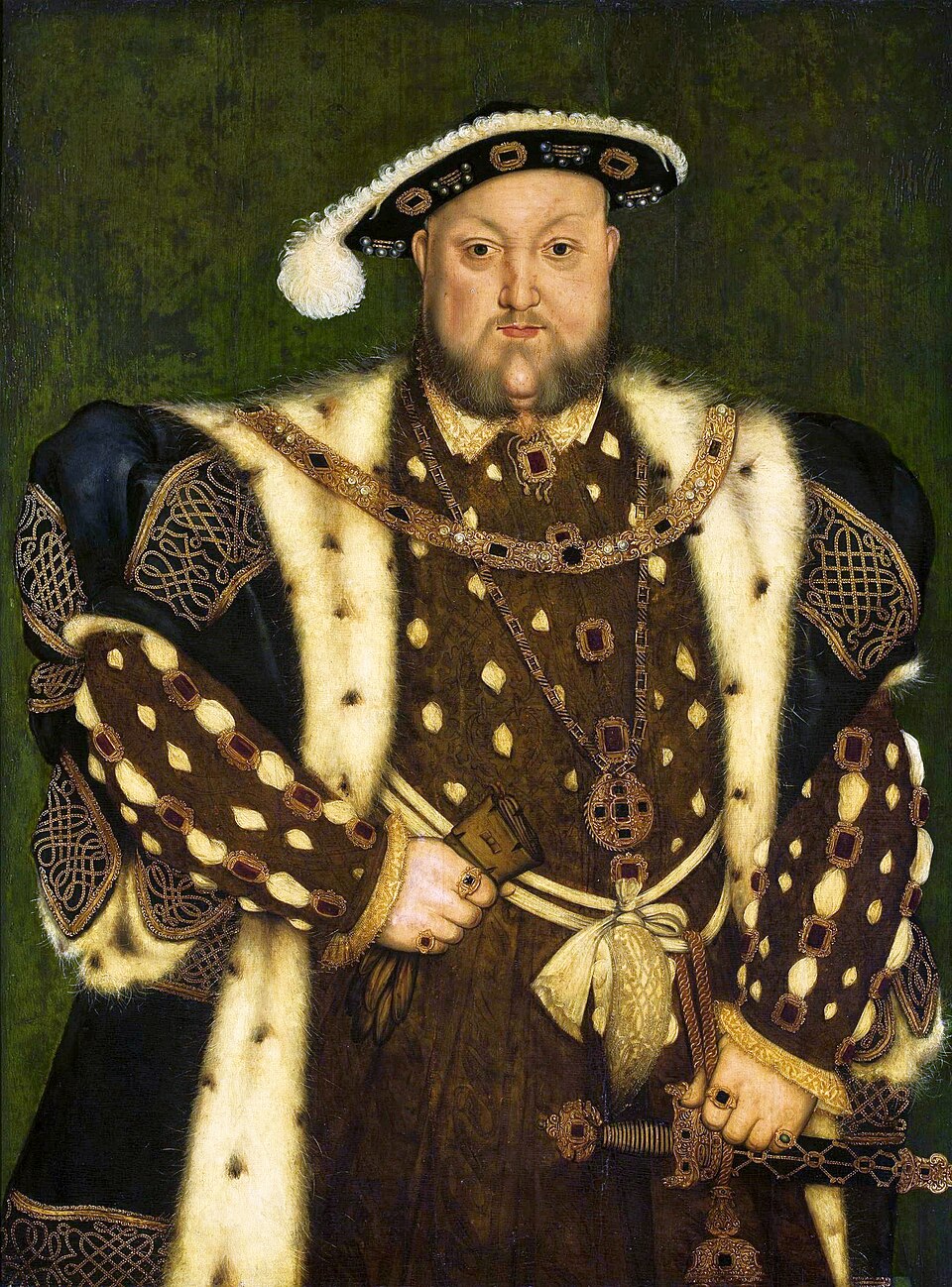
Hans Holbein the Younger, Portrait of Henry VIII, c.1537. Public domain.
Henry VIII faces forward, shoulders squared, filling the frame. He wears a jewel-encrusted doublet beneath a fur-trimmed gown, the fabric heavy with gold thread and pearl embroidery. A feathered hat sits flat across his brow. His hands grip a pair of gloves and rest at his sides. He dominates the space absolutely, not by gesture or action but by sheer physical occupation. There is nowhere in the painting that is not Henry.
The pose is frontal, symmetrical, and confrontational. This is unusual for Tudor portraiture, which overwhelmingly favored the three-quarter view - one shoulder angled toward the viewer, the face turned slightly, the body positioned to suggest depth and social grace. Holbein rejected all of that. He planted Henry square to the picture plane with his shoulders at maximum width and his gaze locked directly on whoever stood before him. The effect is not portraiture in the conventional sense. It is occupation. The king does not inhabit the painting. He fills it.
The panel is small. Approximately 28 by 20 centimeters - barely larger than a hardback book. This is the surviving Thyssen panel portrait, not the Whitehall mural from which it derives. The mural was life-size. The panel is intimate, portable, the kind of image that could be sent to foreign courts as a diplomatic tool or kept in a private chamber as a personal reminder of the sovereign's presence. The fact that the most iconic image of the most famous English king was painted at this scale - a scale you could hold in two hands - is one of the painting's stranger qualities.
Look at the hands. They are not gesturing, not reaching, not holding anything of consequence. The right hand grips a glove. The left rests on a jeweled belt. They are placed symmetrically, framing the torso, doing nothing. In most Tudor portraits the hands carry meaning - they hold letters, rest on books, point to symbols of office or devotion. Henry's hands are deliberately empty. They do not need to hold anything because the body itself is the statement. The hands exist only to complete the symmetry, to close the silhouette at its lower edges the way the hat closes it at the top.
This is the image that defined how the world sees Henry VIII. Not the mural, which burned. Not the copies, which diluted. This small panel, painted on oak, with Holbein's own hand building up the jewels and furs and that flat, implacable stare. Every subsequent depiction - every film, every textbook illustration, every costume drama - traces back to what Holbein decided to do on this piece of wood.
The preparatory cartoon for the Whitehall mural survives. It is held by the National Portrait Gallery in London, and it is the single most important document in the history of Tudor royal image-making. The cartoon shows Henry VIII in three-quarter view, his body turned slightly to the left, one shoulder receding. His torso is noticeably narrower than in the finished painting. His stance is more natural, more human, more like a man standing in a room than a figure engineered to overwhelm.
The final painted version turned him to face the viewer directly. It expanded his shoulders. It broadened his torso. It widened his stance. Holbein literally made the king bigger. The alteration was not subtle - it is immediately visible when the cartoon and the painting are placed side by side. The three-quarter pose, which would have been standard for any courtier or nobleman, was abandoned in favor of something more aggressive: a frontal confrontation that no English royal portrait had attempted before.
The cartoon is pricked for transfer. Tiny holes run along the outlines of the figure - the technique known as pouncing, where charcoal dust is pushed through the perforations to transfer the design onto the wall or panel beneath. The pricked lines follow the narrower, three-quarter body. The painting does not follow them. Somewhere between cartoon and wall, Holbein made a decision - or received an instruction - to abandon the transferred outline and rebuild the figure at a larger scale. The pounced marks told him where the king's shoulders were. He painted them wider.
This is the pentimento. Not a buried correction visible only under X-ray, but a documented, measurable expansion preserved in two surviving objects: the cartoon that shows what Holbein planned, and the painting that shows what he delivered. The gap between the two is the distance between drawing a king and constructing one.
Pose: Three-quarter view in the cartoon, rotated to full frontal in the painting. The turn eliminates depth and creates a flat, heraldic confrontation.
Shoulders: Measurably wider in the painting. The expansion is visible in overlay comparisons and consistent across all surviving copies of the mural composition.
Stance: Feet spread broader, legs planted wider apart. The lower body occupies more horizontal space, anchoring the figure like architecture.
Codpiece: More prominent in the frontal view - centered, padded, jeweled. A feature of costume that the three-quarter pose partially concealed.
Transfer method: The cartoon is pricked for pouncing (charcoal dust pushed through pin holes). The pricked outlines follow the narrower body. The painted figure exceeds them.
What makes this pentimento unusual is its legibility. Most pentimenti are hidden - buried beneath subsequent paint layers, visible only through X-ray or infrared reflectography. This one is preserved in the open, in two objects that anyone can compare. The National Portrait Gallery displays the cartoon in a dedicated room. The Thyssen panel hangs in Madrid. You do not need scientific equipment to see the change. You need only the willingness to look at both and accept what the comparison tells you: that the most powerful image in English royal portraiture was not observed but manufactured, and the manufacturing process is documented.
"Holbein drew the king as he was. Then he painted the king as the king needed to be seen. The distance between the two is the pentimento - and it is the distance between art and power."
The Whitehall mural was commissioned in 1537 to commemorate the Tudor dynasty. It occupied a wall in the Privy Chamber at Whitehall Palace - the king's most private receiving room, where only those granted personal audience would stand. The mural showed four figures: Henry VII and Elizabeth of York, the founders of the dynasty, positioned in the upper register; Henry VIII and Jane Seymour, the reigning couple, below. The composition was a dynastic statement arranged as a family tree made flesh.
The timing was not accidental. Jane Seymour had given birth to Prince Edward on October 12, 1537 - the male heir Henry had spent over two decades, two divorces, one annulment, two executions, and a schism with Rome trying to produce. The mural was a propaganda statement: the Tudor line is secure. The succession is settled. The king who broke with the Pope, dissolved the monasteries, executed Thomas More and John Fisher, and remade the English church in his own image had finally achieved what he set out to do. The mural made this visible. Henry VIII occupied the dominant position - lower center, largest figure, facing forward while his father behind him turned slightly to the side.
The mural was approximately 12 by 9 feet. It was painted directly onto the wall in a combination of oil and tempera over a prepared ground. Holbein executed it rapidly - the commission and completion both fall within 1537 - and it remained in place for 161 years, the single most important piece of English royal propaganda in existence. Every ambassador who entered the Privy Chamber stood before it. Every courtier who sought the king's favor saw it. The mural did not merely depict Henry. It performed him.
The architectural setting of the mural was as deliberate as the figures. Holbein painted an elaborate Renaissance niche behind the royal couple - shell-headed arches, classical pilasters, an ornamental frieze. The architecture was fictive; the Privy Chamber was a Tudor room with oak paneling, not a Roman palace. But the painted setting placed the Tudor dynasty within a classical framework, implying continuity with the emperors of antiquity. Henry VIII was not merely king of England. He was, the mural argued, heir to a tradition of sovereignty that stretched back to Rome.
Jane Seymour died twelve days after Edward's birth, of what was almost certainly puerperal fever. She never saw the completed mural. Her image in the painting shows her alive, composed, standing beside a king whose dynasty she had just secured at the cost of her life. Holbein painted her from studies made before the birth. The mural commemorated a family that existed intact for less than two weeks.
The compositional hierarchy was deliberate to the point of cruelty. Henry VII, the founder, stands behind his son and slightly to the side - diminished, receding, historical. Henry VIII stands in front, larger, facing outward, present tense. The message was not subtle: the father made the dynasty; the son perfected it. The inscription on the plinth between them made this explicit in Latin verse. Holbein was not painting a family. He was painting an argument about succession, and the argument had a winner.
The Whitehall mural was destroyed when Whitehall Palace burned on January 4, 1698. The fire started in a laundry room and spread through the timber-framed Tudor buildings too quickly for anything to be saved from the Privy Chamber. The mural - the original, the life-size confrontation that had intimidated visitors for 161 years - was gone in a matter of hours. Nothing of it survives except the preparatory cartoon and several copies made before the fire. The palace itself was never rebuilt. Only the Banqueting House, designed by Inigo Jones in 1622, survived the blaze. The site of the Privy Chamber is now beneath the pavement of Whitehall, the London street. Tourists walk over it without knowing.
The most important copy was painted by Remigius van Leemput in 1667, thirty-one years before the fire, and is now in the Royal Collection. It shows the full composition - all four figures, the architectural setting, the Latin inscription on the central plinth. But it is a copy. It records the arrangement and the general appearance of the figures without preserving Holbein's brushwork, his specific handling of light on jewels and fur, the exact quality of Henry's stare. Other copies exist in varying degrees of fidelity. None of them is the mural.
The painting that most people know - the image that appears in every textbook, every documentary, every article about Tudor England - is not the mural itself but a separate panel portrait by Holbein, probably derived from the same studies he used for the wall painting. The Thyssen panel is believed to date from around 1537, contemporary with the mural. It may have been a modello, a presentation piece, or a standalone commission. Its precise relationship to the mural is debated. What is not debated is that it is the only surviving painting of Henry VIII certainly by Holbein's own hand in the frontal pose.
The most famous image of the most famous English king is therefore a copy of a copy of a destroyed wall painting. Or, more precisely, a small panel portrait derived from the same studies as a monumental wall painting that no longer exists, supplemented by copies made by other painters who saw the original. The Henry VIII we recognize - the one with the squared shoulders and the flat stare - is a composite assembled from fragments, none of which is the thing itself.
There is a further complication. The Thyssen panel's attribution to Holbein himself, rather than to his workshop, has been debated. Some scholars have argued that certain passages - the handling of the hands, the rendering of specific jewels - show the work of assistants executing a master design. Others maintain that the quality is consistent with Holbein's autograph technique throughout. The panel has been cleaned, restored, and examined with infrared reflectography. The consensus, for now, is that it is substantially by Holbein. But "substantially" is not "entirely," and the distance between the two words is another layer of uncertainty wrapped around an image that most people assume is settled fact.
The physical enlargement of Henry's body between cartoon and painting is measurable and documented. Art historians have overlaid the cartoon onto the Thyssen panel and onto the van Leemput copy, adjusting for scale, and the differences are consistent. The shoulders are wider by a significant margin. The stance is broader. The codpiece - that extraordinary, padded, jeweled projection at the center of the royal anatomy - is more prominent. The three-quarter view becomes frontal, which makes the figure appear not only wider but closer, as though the king is advancing toward the viewer rather than standing at a polite compositional distance.
This was not Holbein correcting an artistic error. The three-quarter cartoon is a competent, finished design - pricked for transfer, ready for use. The change was deliberate. It was a decision to abandon a conventional portrait pose in favor of something unprecedented: a figure engineered to dominate a room. The expansion served a political purpose that the original, more naturalistic pose did not. A king in three-quarter view is a man posing for a painter. A king in frontal view, shoulders at maximum width, eyes locked forward, is something else. He is a wall.
The technique of the expansion is worth noting. Holbein did not simply scale up the figure proportionally. He widened the torso while keeping the head roughly the same size, which produces a subtle but powerful distortion: the body reads as massive relative to the face. The effect is architectural rather than anatomical. The king's body becomes a facade - broad, flat, decorated, imposing - while the face remains human-scaled, watchful, alert. The combination of a human face on a superhuman body is what gives the image its uncanny force. You are looking at a person and a symbol at the same time, and the symbol is winning.
Henry was 45 in 1537 and probably still physically imposing. He had been a celebrated athlete in his youth - tall, broad-shouldered, famous for jousting and wrestling. By the mid-1530s, a jousting injury had begun the decline in mobility that would define his later years, and his weight was increasing. But the painting's proportions go beyond realism into idealization. The torso-to-head ratio is exaggerated. The shoulders extend beyond where anatomy would place them. Holbein was not recording a body. He was constructing a silhouette - a shape designed to read as power from across a room.
The pentimento is the gap between how Henry stood and how Holbein made him appear to stand. It is visible not beneath the paint surface, as most pentimenti are, but in the space between two surviving objects: a cartoon that records the first intention and a painting that records the second. The king was drawn as he was. Then he was painted as he needed to be seen. The distance between the two is the work of political image-making, and it is entirely legible, 489 years later, to anyone who puts the cartoon and the painting side by side.
The mural occupied the king's most private receiving room. It was not a public image. It was not hung in a great hall where hundreds might see it. It was placed in the Privy Chamber, where access was controlled and every visitor was there by invitation or command. To stand before the mural was to stand before the king himself - or, more precisely, to stand before the image that the king had commissioned to represent himself when he was not physically present. The mural was a proxy. It did the king's work of intimidation in his absence.
Visitors reported being unsettled by it. Karel van Mander, the Flemish painter and biographer, wrote in his 1604 treatise Het Schilder-Boeck that the life-size Henry "seemed about to step out of the wall." The phrase has been repeated by art historians for four centuries because it captures something precise about what the mural was designed to do. It was not meant to be admired. It was not meant to be studied for its composition or its color. It was meant to make people physically uncomfortable in the presence of the king's image - to produce in the viewer the same deference, the same instinctive submission, that the king's actual body produced.
Consider the spatial experience. The Privy Chamber was not large. A visitor entering through the door would have encountered the mural at close range - close enough that a life-size figure, painted in Holbein's hyper-detailed technique, would have registered almost as a physical presence. The frontal pose meant that no matter where you stood in the room, Henry was facing you. There was no angle of approach from which the painted king looked away. The room was designed so that the king was always watching, even - especially - when the king was not there.
The Latin inscription on the central plinth, which survives in the van Leemput copy, made the dynastic argument explicit. It asked whether the father or the son was the greater king and answered in Henry VIII's favor: the son had reformed the church, restored true religion, and secured the succession. The mural was not neutral. It was not a family portrait in any domestic sense. It was an argument, painted at life scale, designed to close the question of legitimacy by overwhelming the viewer with the physical and rhetorical presence of the ruling king.
When the palace burned on January 4, 1698, the mural was lost. It had survived the reigns of Edward VI, Mary I, Elizabeth I, James I, Charles I, the Commonwealth, Charles II, James II, and William III. It had outlasted the dynasty it commemorated. It had been the single most reproduced, most copied, most influential image in English art for 161 years. And then it was gone. A laundry fire, a timber palace, and an hour of flame erased the original forever. What we have now are approximations - the cartoon, the copies, the small panel - and the knowledge of what stood on that wall.
The loss changed how the image functions. A surviving mural would be a specific object in a specific room - visitable, photographable, fixed. Its destruction turned Henry's image into something more diffuse and more powerful: a pattern that exists only in copies, each one slightly different, none authoritative, all of them pointing back to a thing that is no longer there. The image of Henry VIII is, in this sense, more like a myth than a painting. It has no single source. It propagates through repetition. And the repetition began with Holbein's decision, in 1537, to make the king wider than the king actually was.
Hans Holbein the Younger was a German painter from Augsburg who arrived in England in 1526 on the recommendation of Erasmus of Rotterdam. Erasmus wrote to Thomas More: "The arts here are freezing; he is on his way to England to pick up some angels." The pun on the English gold coin was deliberate. Holbein came because there was money and because the market for painters in Basel, where he had been working, had collapsed under the iconoclasm of the Reformation. He brought with him a technical facility that no English painter could match - a capacity for rendering texture, fabric, skin, and jewels with a precision that was closer to Flemish panel painting than to anything the English court had seen.
He became the king's painter. The title was not honorary. It carried obligations, and those obligations included producing images that served the crown's political interests. Holbein painted six of Henry's wives. He painted ambassadors, courtiers, merchants, scholars. He designed jewelry, pageant decorations, and title pages for printed books. He was, in modern terms, the creative director of the Tudor visual identity - the person responsible for how the monarchy appeared to itself and to the world.
His most consequential failure - the portrait of Anne of Cleves, Henry's fourth wife - illustrates the danger. Holbein was sent to paint Anne before the marriage, and the portrait he returned with was flattering enough that Henry agreed to the match. When Anne arrived in England, Henry found her physically unappealing and blamed the painter. The marriage lasted six months. Cromwell, who had brokered the alliance, was executed. Holbein survived - barely - but the incident demonstrated what every court painter understood: the gap between what you paint and what the patron sees in the flesh is a space where careers and lives are destroyed.
His position required him to balance artistic honesty with political survival. Henry VIII executed people for less than an unflattering portrait. Thomas More, who had introduced Holbein to the English court, was beheaded in 1535. Thomas Cromwell, who became Holbein's principal patron after More's death, was beheaded in 1540. The court was lethal. A painter who made the king look weak, or old, or fat in the wrong way, was not risking his commission. He was risking his life. Holbein navigated this for seventeen years, producing images that satisfied the crown without descending into obvious flattery - images that felt true enough to be credible and powerful enough to serve.
The expansion of Henry's body was not artistic license in any conventional sense. It was professional survival in a court where the wrong painting could end a career or a life. Holbein drew the king as he appeared. Then he looked at what he had drawn and understood that it was not enough - that the king required not accuracy but amplification. The pentimento is the record of that understanding. It is the moment when the painter's eye yielded to the painter's judgment, and the judgment said: wider.
Holbein died in London in 1543, probably of plague. He was approximately 45 years old. He left behind no diary, no treatise on painting, no written account of his methods or his relationship with the king. What he left was the image - the expanded, confrontational, immovable image of Henry VIII that has outlasted every other representation of the Tudor monarchy. There is an irony in this. The painter who made the king immortal is himself barely documented. We know what Holbein saw because he painted it. We do not know what he thought, what he feared, or whether the decision to widen the king's shoulders was his idea or an instruction delivered by a courtier who understood what the king wanted to see. The cartoon records one version. The painting records another. The space between them is silence.
National Portrait Gallery, London. Holbein cartoon (NPG 4027): conservation records and display notes. The cartoon is the primary document for the Whitehall mural composition and the only surviving preparatory work certainly by Holbein's hand.
Thyssen-Bornemisza Museum, Madrid. Collection records for Portrait of Henry VIII (inv. no. 1934.39). The panel entered the Thyssen collection in 1934 and has been exhibited continuously since.
Foister, Susan. Holbein and England. Yale University Press, 2004. The definitive modern study of Holbein's English career, including detailed analysis of the Whitehall mural commission and the relationship between cartoon and painted versions.
Strong, Roy. Tudor and Jacobean Portraits. National Portrait Gallery, 1969. Catalogue raisonné of the NPG's Tudor holdings, including the Holbein cartoon.
Van Mander, Karel. Het Schilder-Boeck. Haarlem, 1604. The earliest biographical account of Holbein's work in England, including the report that the Whitehall Henry "seemed about to step out of the wall."